
Entebbe Zoo Entrance Fee 2026 – — Complete Visitor Guide
Uganda Wildlife Education Centre (UWEC): Opening Hours, Ticket Prices, Activities, Animals, Tips & How to Get There
The Entebbe Zoo entrance fee in 2026 for non-resident adults is USD $15 per person, and USD $10 for non-resident children aged 3 to 14 years.
East African adults pay UGX 20,000 and East African children pay UGX 10,000. These fees took effect on July 1, 2024 — the first fee revision in over a decade — and remain current as of 2026.
The zoo (officially the Uganda Wildlife Conservation Education Centre, or UWEC) is open daily from 8:00 AM to 6:00 PM, including weekends and public holidays.
Full pricing by category, opening hours, activities, animals, directions, and travel tips are all covered in detail below.
Entebbe Zoo Entrance Fees 2026: Full Price Breakdown
| Visitor Category | Fee (2026) | Notes |
| Non-resident Adults | USD $15 | Foreign tourists, expatriates — paid in USD or equivalent |
| Non-resident Children (3–14 yrs) | USD $10 | Under 3 years: free entry |
| East African Adults | UGX 20,000 | Citizens of Uganda, Kenya, Tanzania, Rwanda, Burundi, South Sudan |
| East African Children (3–14 yrs) | UGX 10,000 | EAC member country citizens |
| Booked School Groups (per student) | UGX 8,000 | Pre-booked educational visits only |
| Tertiary Institutions (per student) | UGX 8,000 | Universities and colleges — pre-booking required |
| Accompanying Teachers | UGX 10,000 | One free teacher per 20 students — confirm on booking |
| Vehicle Parking Fee | UGX 2,000 | Per vehicle, charged at entrance |
| Video Recording Fee | UGX 10,000 | Applies to video cameras — standard photography permitted |
| Behind the Scenes Tour | Separate rate | Premium guided access — book in advance, limited spaces |
Important note: Fees shown are current as of July 2024 and verified for 2026. UWEC management reserves the right to revise rates without advance notice.
Always confirm current pricing directly with UWEC before your visit: call +256 414 320 520 or visit uwec.ug. Payment is accepted in USD and Ugandan Shillings (UGX). Card payment may be available — carry cash as a backup.
Entebbe Zoo Opening Hours 2026
| Opening time | 8:00 AM daily (including weekends and public holidays) |
| Closing time | 6:00 PM daily — last entry strictly at 6:00 PM |
| Recommended arrival | 8:00 AM – 10:00 AM for best animal activity and cooler temperatures |
| Recommended departure | By 4:00 PM to allow full exploration before closing |
| Christmas & public holidays | Open every day of the year including Christmas Day and Eid |
| Best days to visit | Weekday mornings — fewest crowds, most active animals |
| Avoid | Midday (12:00–2:00 PM) — animals rest in the heat; crowds peak on Sunday afternoons |
Visitors who arrive close to 6:00 PM will not be admitted. The zoo recommends arriving no later than 4:00 PM to allow adequate time for a full visit covering the main animal enclosures, the forest trail, and the lakeside area.
Morning visits (8:00–11:00 AM) are ideal — chimpanzees, big cats, and primates are most active in cooler morning temperatures and the light is best for photography.
What Is the Entebbe Zoo? UWEC Explained
The Entebbe Zoo — officially the Uganda Wildlife Conservation Education Centre (UWEC) — is Uganda’s premier wildlife education facility and one of the most visited tourist attractions in the country.
Located on 72 acres of lakeshore land along the shores of Lake Victoria in Entebbe, just 15 minutes from Entebbe International Airport, UWEC offers visitors up-close encounters with Uganda’s extraordinary wildlife in a setting that combines animal conservation, education, and natural beauty.
Despite being popularly called a ‘zoo,’ UWEC is fundamentally different from a conventional zoo. It was established in 1950 as a rescue and rehabilitation centre for orphaned, injured, and confiscated animals — and this conservation mission remains central today.
The animals at UWEC are largely individuals that cannot be released back into the wild due to injury, habituation to humans, or other factors.
The facility also runs a captive breeding programme for endangered species and contributes to wildlife research across Uganda.
The centre is ranked among the top three tourist attractions in Entebbe on TripAdvisor and consistently receives strong reviews from international visitors for the quality of animal encounters, the natural forest setting, and the educational value of the experience.
For families, for transit passengers with a few hours before a flight, and for Uganda safari travellers wanting a wildlife warm-up near the capital — UWEC is a superb choice.
Entebbe Zoo Location and How to Get There
| Official address | Plot 56/57 Lugard Avenue, Entebbe, Uganda |
| GPS coordinates | 0.0642 degrees North, 32.4464 degrees East |
| Distance from airport | Approximately 4 km — 10 to 15 minutes by taxi or boda-boda |
| Distance from Entebbe town centre | Approximately 1.5 km — 5 to 10 minutes on foot or by boda |
| Distance from Kampala | Approximately 40 km — 45 minutes to 1.5 hours depending on traffic |
| Phone | +256 414 320 520 |
| Website | uwec.ug |
From Entebbe International Airport
Entebbe Zoo is one of the most conveniently located wildlife attractions in East Africa for air travellers. From the airport arrival terminal, a taxi to UWEC takes approximately 10 to 15 minutes and costs UGX 15,000–30,000 ($8–15 USD) depending on negotiation.
Boda-boda (motorcycle taxis) take the same time for UGX 5,000–8,000. This proximity makes UWEC the perfect activity for travellers with a long layover, an early evening flight, or a day to spare in Entebbe before or after a Uganda safari.
From Kampala
From Kampala city centre, the drive to Entebbe Zoo takes approximately 45 minutes to 1.5 hours depending on traffic — the Kampala–Entebbe Expressway has significantly reduced travel time.
A special hire taxi from Kampala costs approximately UGX 60,000–100,000 ($35–55 USD) one way. Shared taxis (matatus) from Kampala Old Taxi Park to Entebbe cost UGX 3,000–5,000 and drop passengers at Entebbe town, a short boda-boda ride from UWEC. A day trip from Kampala to Entebbe Zoo is easily done and makes an excellent weekend excursion.
Animals at Entebbe Zoo: What Will You See?
Entebbe Zoo houses one of the most diverse collections of Ugandan and East African wildlife of any facility in the region. The 72-acre site supports over 120 bird species, more than 23 primate species, and dozens of mammal, reptile, and amphibian species.
Unlike national parks where animal sightings are never guaranteed, UWEC offers reliable, close-up encounters with a wide range of species — making it particularly valuable for families with children, wildlife photographers, and first-time Africa visitors.
Big Cats and Large Predators
- Lions — seen resting in shaded enclosures; best viewed in the morning when most alert
- Leopards — more secretive but visible in their naturalistic enclosures
- Cheetahs — among the more active of the big cats at UWEC, often visible pacing and feeding
- Hyenas — spotted hyenas can be seen in a dedicated enclosure
Primates — A UWEC Speciality
- Chimpanzees — UWEC’s most popular resident. A semi-wild chimpanzee community lives in a large, forested enclosure. The ‘Behind the Scenes’ tour allows visitors access alongside a keeper for a close-up experience. These are rescued and rehabilitated individuals that cannot be returned to the wild.
- Red-tailed monkeys, olive baboons, vervet monkeys — commonly seen throughout the facility, some moving semi-freely
- Black-and-white colobus monkeys — in forested areas of the facility
- Grey-cheeked mangabeys and L’Hoest’s monkeys — more unusual primates visible in dedicated sections
Elephants and Large Mammals
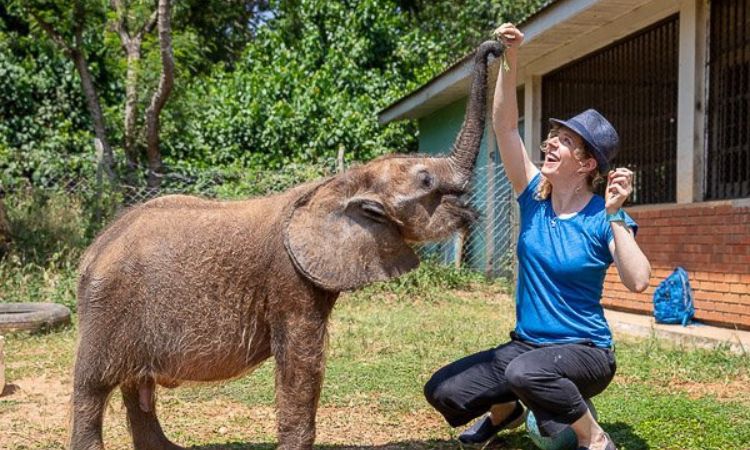
- African elephants — UWEC maintains a small elephant population; best viewed at feeding times
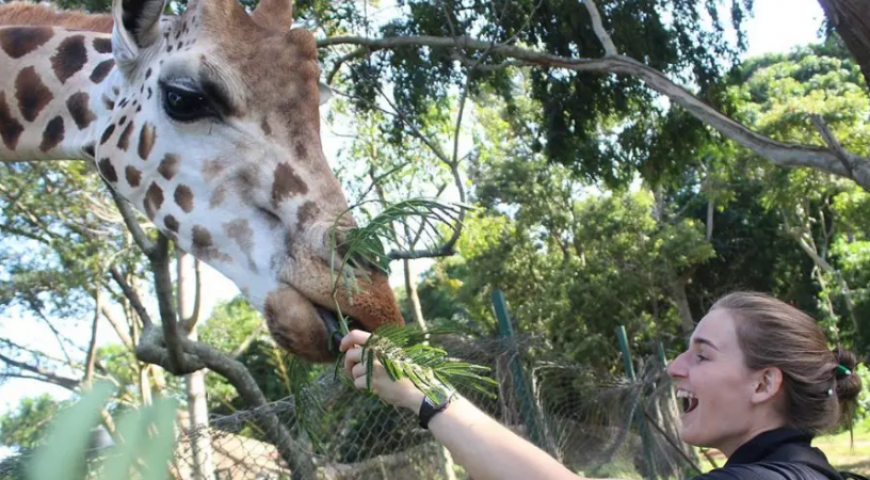
- Rothschild’s giraffes — one of the world’s most endangered giraffe subspecies; the giraffe platform at UWEC allows face-to-face feeding encounters
- Hippos — visible in the lakeside hippo pond; particularly active in the morning
- White rhinoceros — UWEC is one of very few facilities in Uganda where rhinos can be seen
- Zebras, Uganda kob, waterbuck, impala, topi, eland — savannah species in open enclosures
- Warthogs, forest hogs — often seen semi-freely roaming the grounds
Reptiles
- Nile crocodiles — in a dedicated pond enclosure
- African rock pythons and other snake species — in the reptile house
- African spurred tortoise and other tortoise species
- Monitor lizards — Nile monitors are commonly seen around the lake edge
Birds — 120+ Species
UWEC is a superb birding site within the Entebbe area. Over 120 bird species have been recorded within the centre, including both captive and free-flying wild birds attracted by the natural forest and Lake Victoria shoreline. Key species include:
- Shoebill Stork (Balaeniceps rex) — one of Africa’s most sought-after birds. UWEC keeps rescued Shoebills and is one of the most reliable places in Uganda to see this extraordinary prehistoric bird up close.
- Grey Crowned Crane — Uganda’s national bird, present at UWEC
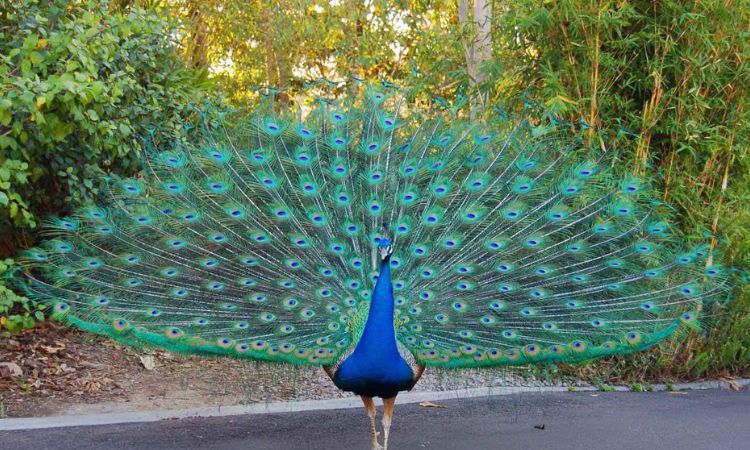
- African grey parrots, crested cranes, peacocks, ostriches
- Various kingfishers, herons, egrets, and weavers in the natural lakeside vegetation
Activities at Entebbe Zoo Beyond Animal Viewing
The Forest Walk (Included in Entry Fee)
One of UWEC’s most distinctive features is its 1-kilometre natural forest walk through a section of indigenous lakeshore forest within the facility grounds.
The trail passes beneath towering fig trees draped with epiphytes, alongside papyrus fringes of Lake Victoria, and through dense undergrowth alive with birds, butterflies, and occasionally wild primates.
This is not a manufactured zoo experience — it is a genuine forest environment that happens to sit within the facility boundary. The walk takes 30 to 60 minutes at a leisurely pace and is included in the standard entry fee.
Behind the Scenes Tour — The Premium Experience
The Behind the Scenes Tour is UWEC’s most coveted experience and the one most frequently cited by visitors as the highlight of their visit.
Under the supervision of an animal keeper, small groups are taken into the animal enclosures — including the chimpanzee area — for a guided, close-up experience that is simply not available anywhere else in Uganda at this price point.
The tour provides a genuinely intimate wildlife encounter and an insight into the daily work of wildlife conservation. Spaces are strictly limited and the tour sells out in advance, especially during weekends and peak tourist season.
Book through UWEC directly or through your safari operator. An additional fee applies — confirm current pricing when booking.
Boat Rides on Lake Victoria
From UWEC’s own pier on the Lake Victoria shoreline, boat rides are available for UGX 20,000 per person. The short trip onto the lake offers excellent views of the shoreline, birdwatching opportunities for kingfishers, herons, African fish eagles, and pied kingfishers, and occasionally hippo sightings from the water.
The breeze off the lake is cooling and the views back toward the Entebbe peninsula are scenic. This is a worthwhile add-on, particularly for birdwatchers.
Giraffe Feeding Platform
UWEC operates a giraffe feeding platform where visitors can hand-feed Rothschild’s giraffes face to face — the same experience that draws visitors to the famous Giraffe Centre in Nairobi, but at a fraction of the price and with far fewer crowds.
The Rothschild’s giraffe is one of the most endangered giraffe subspecies in the world, and UWEC’s population is part of a broader conservation effort. Feeding times are scheduled — confirm on arrival. This is a particular highlight for families with children.
Educational Workshops and Conservation Programmes
UWEC offers structured educational workshops led by conservation staff for school groups, university students, and interested individuals. Workshops cover topics including wildlife conservation, biodiversity, ecology, and Uganda’s national parks.
Volunteer opportunities are also available for longer-term visitors — contact UWEC directly for details on their volunteer programme.
Picnic Areas and the Lakeside Restaurant
UWEC maintains well-kept picnic areas throughout the grounds, shaded by large trees with views over Lake Victoria. Visitors are welcome to bring their own food and picnic within the facility.
The lakeside restaurant serves Ugandan and international food and is a pleasant spot for lunch with a breeze off the lake. It is one of the best-located lunch spots in Entebbe for the combination of setting, affordability, and accessibility. Soft drinks, water, local beers, and basic snacks are also available at kiosks within the grounds.
Gift Shop and Souvenirs
UWEC operates a gift shop near the entrance selling locally made crafts, wildlife-themed souvenirs, educational books, and conservation merchandise.
Purchases support UWEC’s conservation and community programmes. This is a good place to pick up a distinctive Uganda souvenir — one that contributes to wildlife conservation rather than a generic gift shop.
Entebbe Zoo as a Layover Activity: The Perfect Airport Stop
For travellers transiting through Entebbe International Airport with 4 to 8 hours between flights, Entebbe Zoo is the single best use of that time in the entire Entebbe area. The airport to UWEC journey takes just 10 to 15 minutes by taxi. Here is a practical layover plan:
6-Hour Layover Itinerary at Entebbe Zoo
Arrive at UWEC by 9:00 AM. Secure your luggage at the entrance storage. Spend the first 90 minutes on the main animal loop: chimpanzees, lions, giraffes, rhinos, and elephants.
Take a 45-minute forest walk. Visit the Shoebill enclosure (allow 20 minutes — this bird is extraordinary and deserves time). Take a 30-minute lake boat ride.
Enjoy lunch at the lakeside restaurant (budget UGX 15,000–30,000 for a meal). Browse the gift shop. Depart by 3:00 PM for a comfortable return to the airport — well within time for a 6:00 PM flight.
This plan converts a dull airport wait into a genuine wildlife experience and one of Uganda’s most memorable half-days.
Photography Tips for Entebbe Zoo
- Visit in the morning (8:00–11:00 AM) for the best natural light and most active animals — especially chimpanzees, big cats, and birds
- A zoom lens of 200mm or longer is recommended for animal portraits without bars or fence lines in the frame
- The Shoebill Stork is a photography highlight — approach slowly and quietly; the bird tolerates patient observers well
- The giraffe feeding platform offers exceptional close-up portrait opportunities — wide-angle lenses work well here for dramatic perspective
- The forest walk produces good bird photography opportunities — look for kingfishers at the lake edge
- Video camera use requires a UGX 10,000 additional fee paid at the gate — budget accordingly
Practical Tips for Visiting Entebbe Zoo in 2026
- Book the Behind the Scenes Tour in advance — it sells out, especially on weekends and during peak Uganda tourism season (June–August, December–January)
- Carry cash in both USD and Ugandan Shillings — USD for non-resident entry fees, UGX for parking, video fees, food, and boat rides
- Wear comfortable, closed-toe walking shoes — you will cover several kilometres on various surfaces including forest paths and grass
- Bring a hat, sunscreen, and water — the Entebbe sun is strong, particularly in open sections of the facility midday
- Visit on a weekday morning for the smallest crowds and most active animals — Sunday afternoons are the busiest time
- The facility is family-friendly and accessible for most mobility levels on the main paths; the forest trail involves some uneven terrain
- Do not feed the animals except at designated feeding stations (giraffe platform, chimp area with keeper) — unapproved feeding disrupts animal diets and behaviour
- Respect the animal enclosures — do not reach through barriers or attempt to touch animals outside supervised encounters
- Check UWEC’s website or call ahead for current special events, feeding times, and Behind the Scenes tour availability
Entebbe Zoo vs. Uganda National Parks: Which Should You Choose?
A common question from visitors is whether Entebbe Zoo is a substitute for Uganda’s famous national parks — Bwindi, Murchison Falls, Queen Elizabeth, or Kibale. The honest answer is that they serve very different purposes and are best understood as complementary rather than competing experiences.
Entebbe Zoo is ideal for: travellers with limited time (a few hours to a day); families with young children who want guaranteed close-up animal encounters; visitors on a tight budget who cannot afford national park entry fees and safari costs; transit passengers using a layover productively; and anyone wanting an introduction to Uganda’s wildlife before or after a longer safari.
Uganda national parks are essential for: the genuine wild safari experience with animals in their natural habitat; gorilla trekking in Bwindi ($800 per person — the world’s best gorilla experience); chimpanzee trekking in Kibale; the Nile boat cruise at Murchison Falls; lion and elephant game drives in Queen Elizabeth National Park; and serious birdwatching with 1,060+ species accessible across the country.
The ideal Uganda safari tinerary combines both: start with a morning at Entebbe Zoo to orientate yourself to Uganda’s wildlife before heading upcountry for a full national park safari — then return to Entebbe Zoo for a final morning before your departure flight. Many Gorilla Trackers Uganda itineraries are designed exactly this way.
Brief History of Entebbe Zoo (UWEC)
Entebbe Zoo was established in 1950 by the British colonial government as a wildlife reception centre for orphaned, injured, and confiscated animals.
It was founded with support from the Wildlife Conservation Society and operated initially as a rehabilitation facility rather than a public attraction.
By 1960, it had evolved into a traditional zoo, adding non-indigenous species and becoming a popular public attraction for both locals and colonial settlers.
Uganda’s political turbulence of the 1970s and 1980s under Idi Amin and the subsequent years of civil conflict led to serious decline — infrastructure broke down, animals died, and the facility fell into disrepair.
By the early 1990s UWEC was in a state of near-collapse. A major rehabilitation effort in the mid-1990s transformed the facility into its current form: a modern conservation and education centre focused on native Ugandan and East African species, rehabilitation of rescued animals, captive breeding of endangered species, and public environmental education.
The facility was officially renamed the Uganda Wildlife Conservation Education Centre (UWEC) to reflect this changed mission. The most recent significant development was the July 2024 entry fee revision — the first in over a decade — which raised funds for continued facility improvement and animal welfare enhancement.
FAQs: Entebbe Zoo Entrance Fee 2026
How much is Entebbe Zoo entrance fee in 2026?
The Entebbe Zoo entrance fee in 2026 is USD $15 for non-resident adults and USD $10 for non-resident children aged 3 to 14. East African adults pay UGX 20,000 and East African children pay UGX 10,000. Children under 3 years enter free.
These are the current rates that took effect on July 1, 2024. A vehicle parking fee of UGX 2,000 applies separately, and video camera use costs an additional UGX 10,000.
What time does Entebbe Zoo open and close?
Entebbe Zoo (UWEC) opens at 8:00 AM and closes at 6:00 PM every day of the year, including weekends, Christmas Day, and all public holidays. Last entry is at 6:00 PM — no admissions after this time. The best time to visit is between 8:00 and 11:00 AM when animals are most active and temperatures are cooler.
How do I get to Entebbe Zoo from the airport?
Entebbe Zoo is approximately 4 km from Entebbe International Airport — a 10 to 15 minute taxi ride costing UGX 15,000–30,000 ($8–15 USD).
Boda-boda motorcycle taxis take the same time and cost UGX 5,000–8,000. From Kampala, the drive takes 45 minutes to 1.5 hours depending on traffic; shared taxis to Entebbe cost UGX 3,000–5,000 from the Old Taxi Park.
What animals can you see at Entebbe Zoo?
Entebbe Zoo houses lions, leopards, cheetahs, African elephants, Rothschild’s giraffes, white rhinos, hippos, zebras, Nile crocodiles, chimpanzees, and a large variety of monkeys and primates.
Over 120 bird species are present including the rare Shoebill Stork and Uganda’s national bird, the Grey Crowned Crane. The full species list includes over 300 individual animals across dozens of species.
Is Entebbe Zoo worth visiting?
Yes — Entebbe Zoo is one of Uganda’s best-value wildlife experiences and consistently receives excellent reviews from international visitors.
For the entry fee of $15, you gain access to 72 acres of natural lakeshore habitat, close encounters with lions, giraffes, chimpanzees, rhinos, and elephants, a 1-km forest walk, lake boat rides, and the opportunity to see the Shoebill Stork — one of Africa’s most sought-after birds — all within 15 minutes of the international airport.
It is outstanding value compared to national park fees and offers guaranteed animal sightings that no game drive can promise.
Can I see gorillas at Entebbe Zoo?
No — mountain gorillas are not kept at Entebbe Zoo. To see mountain gorillas you must trek in Bwindi Impenetrable National Park or Mgahinga Gorilla National Park in southwestern Uganda (permits cost USD $800 per person) or in Volcanoes National Park in Rwanda (permits cost USD $1,500).
At Uganda Wildlife Tours, we arranges gorilla trekking permits and full safari packages to Bwindi — contact us today to book.
What is the Behind the Scenes Tour at Entebbe Zoo?
The Behind the Scenes Tour is a premium guided experience at UWEC where a small group accompanies an animal keeper into the animal management areas — including close proximity to the chimpanzees and other species — for an intimate, educational wildlife encounter not available on the standard visit.
Spaces are very limited and it is one of the most sought-after experiences in Entebbe. Book in advance through UWEC (+256 414 320 520) or through your Uganda safari operator.
Is Entebbe Zoo suitable for children?
Entebbe Zoo is one of the most family-friendly wildlife attractions in Uganda and East Africa. Children love the giraffe feeding platform, chimpanzee viewing, the giraffe and elephant encounters, and the forest walk.
The main paths are accessible and manageable for children of all ages. Entry for children aged 3 to 14 is discounted ($10 for non-residents, UGX 10,000 for East Africans), and children under 3 enter free.
Plan Your Uganda Safari
- Uganda Gorilla Trekking in Bwindi — $800 permits, the world’s best gorilla experience
- Chimpanzee Trekking in Kibale National Park — Uganda’s premier chimp forest
- Murchison Falls National Park Safari — lions, elephants, giraffes, and the Shoebill Stork
- Things to Do in Entebbe — a complete visitor guide to Uganda’s gateway city
- Uganda Birding Tours — the Shoebill Stork, Great Blue Turaco, and 1,060+ species
- All Uganda Safari Packages — tailored itineraries for every budget and interest
Visit Entebbe Zoo — and Then Explore All of Uganda with Gorilla Trackers
At USD $15 for adults, Entebbe Zoo is one of the best-value wildlife experiences not just in Uganda but in all of Africa. The Shoebill Stork alone — a bird that serious birders travel across continents to see — is worth the entry fee several times over.
Add chimpanzees, Rothschild’s giraffes, lions, rhinos, and a forested Lake Victoria shoreline, and UWEC makes an exceptional half-day or full-day experience for any Uganda visitor.
But Entebbe Zoo is only the beginning. Uganda is one of the most biodiverse and wildlife-rich countries on Earth — home to mountain gorillas, chimpanzees, the Nile, Murchison Falls, the Kazinga Channel, Kibale Forest, and over 1,060 bird species.
If a morning at Entebbe Zoo leaves you wanting more — and it will — Gorilla Trackers Uganda is ready to take you deeper into the Pearl of Africa.
Book Your Uganda Safari with us today.
- Gorilla trekking in Bwindi Impenetrable Forest — Uganda’s most iconic experience
- Chimpanzee tracking in Kibale National Park — combined with Bigodi Wetland Sanctuary
- Murchison Falls National Park safaris — boat cruise, game drives, Shoebill spotting
- Queen Elizabeth National Park — tree-climbing lions, Kazinga Channel, crater lakes
- Rwanda + Uganda combination packages — gorillas, Lake Kivu, Kigali, and East Africa highlights
- Customized itineraries for families, couples, honeymooners, solo travellers, and groups
Start planning your Uganda safari today!
Entebbe Zoo: where every Uganda safari begins, and where the Shoebill is always worth the wait.

