
Zebra Top Facts: Habitat, Diet, Behavior, & Where to See Them in Africa
The Zebra is one of Africa’s most recognizable animals, known for its unique black-and-white stripes and social behavior. These striking equids captivate safari-goers with their bold patterns and lively herds, making them a highlight of any wildlife adventure across East Africa.
Zebras belong to the genus Equus, closely related to horses and donkeys, but they remain distinctly wild and untamed. Found primarily in sub-Saharan Africa, they thrive in open landscapes where they graze and interact in tight-knit groups.
Their presence signals healthy grasslands and supports tourism in countries like Kenya, Tanzania, and Uganda. Whether you spot them during a game drive or as part of the legendary Great Migration, zebras embody the raw beauty of the African savanna.
This comprehensive guide covers zebra facts, including their different species, zebra habitat, zebra diet, behavior, survival strategies, and why their stripes matter. We also compare them to horses and share practical safari tips for seeing them in the wild.
Zebra Species
There are three main species of zebras, each adapted to specific environments and displaying unique stripe patterns, sizes, and behaviors.
- Plains Zebra (Equus quagga)
The most common and widespread species, often called the common or Burchell’s zebra. Plains zebras have broad black-and-white stripes, frequently with faint “shadow” stripes between the main ones. They stand about 3.6 to 4.8 feet at the shoulder and weigh 386 to 849 pounds. This adaptable species lives in large herds across grasslands and savannas. Subspecies include Grant’s zebra, common in the Serengeti and Maasai Mara. - Mountain Zebra (Equus zebra)
This species prefers rugged, rocky terrain and has narrower, cleaner stripes that do not extend fully onto the belly, leaving a white underbelly. A distinctive dewlap (fold of skin) hangs under the throat, and they often show a “gridiron” pattern on the rump with horizontal stripes on the haunches. Mountain zebras are slightly smaller and more compact than plains zebras, with two subspecies: Hartmann’s and Cape mountain zebra. They inhabit arid mountainous areas in Namibia, Angola, and South Africa. - Grevy’s Zebra (Equus grevyi)
The largest and rarest species, Grevy’s zebras feature very narrow, closely spaced stripes and large, rounded ears. They stand up to 5.25 feet at the shoulder and weigh 776 to 992 pounds. Unlike the other species, Grevy’s zebras have a more mule-like appearance and live in semi-arid grasslands. They are classified as Endangered, with populations mainly in northern Kenya and parts of Ethiopia. Grevy’s zebras form looser social groups compared to the harem-based structures of plains zebras.
These differences in stripe width, body size, and habitat preferences help researchers and safari guides identify species quickly in the field.
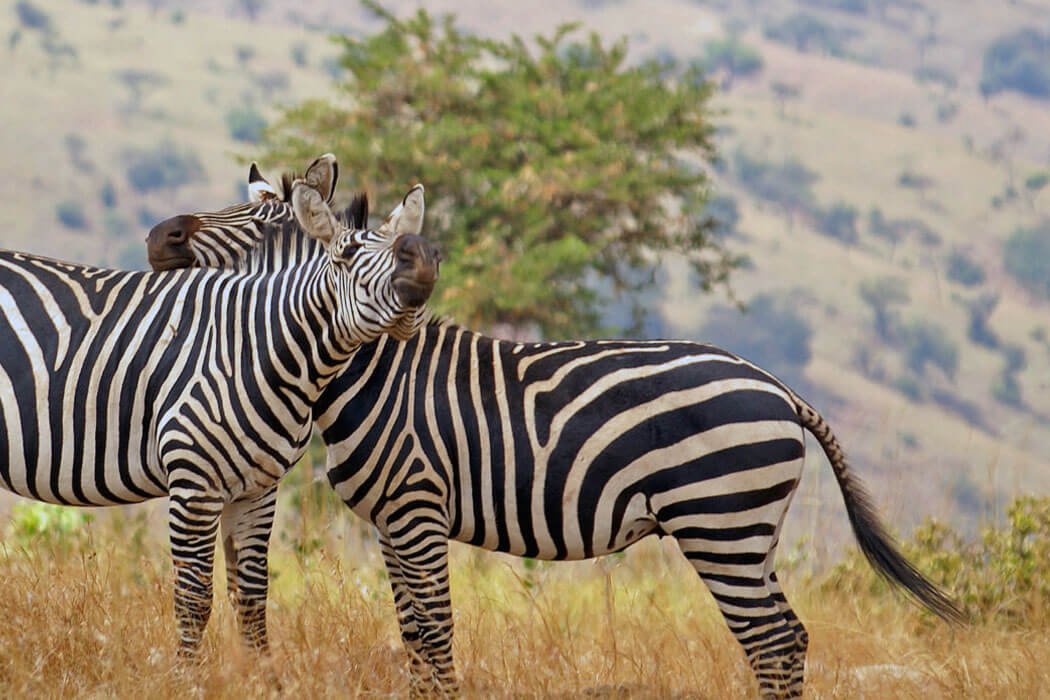
Where Do Zebras Live? Zebra Habitat Explained
Zebras inhabit a variety of African landscapes, but they favor open areas with plenty of grass and access to water.
- Plains Zebras: Thrive in savannas, grasslands, and woodlands of East and southern Africa. They are commonly seen in Kenya’s Maasai Mara, Tanzania’s Serengeti, and parts of Uganda.
- Mountain Zebras: Adapted to rocky slopes and hilly regions with sparse vegetation.
- Grevy’s Zebras: Prefer dry, semi-desert grasslands.
In East Africa, key countries include:
- Kenya: Abundant plains zebras in the Maasai Mara and Grevy’s in northern conservancies like Lewa.
- Tanzania: Massive populations in the Serengeti ecosystem.
- Uganda: Plains zebras are prominent in Lake Mburo National Park and Kidepo Valley National Park, where they graze alongside other herbivores.
Zebras need fresh grass and water daily, so they avoid dense forests and extreme deserts. Their habitats overlap with other grazers, creating dynamic ecosystems where different species help each other by cropping grass at varying heights.
What Do Zebras Eat? Zebra Diet
Zebras are strict herbivores and primarily grazers. Their zebra diet consists mainly of grasses, which they crop with sharp front teeth and grind with durable back molars designed for tough, silicate-rich vegetation.
- They favor nutrient-rich short grasses but also consume taller, coarser varieties that other herbivores might avoid.
- Occasionally, they browse on leaves, shrubs, buds, bark, and small trees when grass is scarce.
- Zebras can survive several days without water by obtaining moisture from plants, though they prefer daily access to drinking sources.
This grazing habit makes zebras ecological pioneers: they eat the older, tougher grass, allowing fresher shoots to grow for species like wildebeest that follow them. For a deeper dive into their feeding habits, explore our dedicated guide on what zebras eat.
Behavior & Social Life
Zebras are highly social animals that live in herds for protection and companionship. Plains zebras typically form stable “harems” consisting of one dominant stallion, several mares, and their foals. These family units often join larger temporary herds of hundreds or thousands.
- Strong social bonds exist within groups; zebras recognize each other by stripe patterns, vocalizations (barks and brays), and scent.
- They groom one another, reinforcing relationships and removing parasites.
- Stallions defend the harem aggressively against rivals or predators, using bites and powerful kicks.
- Grevy’s zebras have a more fluid social structure, with looser associations centered around water sources or foal relationships.
Zebras communicate through sounds, facial expressions, and body posture. Their alertness and constant movement help the herd stay safe in predator-rich environments.
Predators & Survival Strategies
Main predators include lions, hyenas, leopards, cheetahs, and African wild dogs. Crocodiles pose threats during river crossings.
Zebras rely on speed—they can reach 35–40 mph (up to 65 km/h in short bursts)—and group vigilance. When threatened, the herd bunches together, making it difficult for a predator to single out one individual.
Their stripes play a key role in survival (detailed below). Foals are vulnerable, so mothers keep them close, and the group provides collective defense through kicking and charging.
Why Do Zebras Have Stripes?
This is one of the most engaging zebra facts. No single theory explains it fully, but science points to multiple benefits:
- Insect Protection: The leading hypothesis is that stripes deter biting flies like horseflies and tsetse flies. The contrasting pattern disrupts the flies’ visual processing, making it harder for them to land. Zebras have shorter hair, increasing vulnerability, so stripes act as a natural repellent. Experiments with striped models and painted animals support this.
- Camouflage and Motion Dazzle: In a herd, overlapping stripes create optical illusions that confuse predators, especially during movement. Lions may struggle to focus on a single target.
- Heat Regulation: Black stripes absorb heat while white ones reflect it, potentially creating air currents for cooling—though recent tests question how significant this effect is.
- Individual Recognition: Each zebra’s stripe pattern is unique, like a fingerprint, helping foals imprint on mothers and group members identify one another.
Stripes develop in the womb and darken after birth. The skin underneath is black, with melanin determining fur color.
Zebra Migration: Following the Great Migration
Many zebras participate in Africa’s epic Great Migration. Around 300,000 zebras join over 1.2 million wildebeest and gazelles in a circular journey across the Serengeti-Mara ecosystem.
- Zebras often lead, cropping tall grasses and making way for wildebeest.
- The movement follows seasonal rains for fresh grazing and water, covering hundreds of kilometers annually.
- Dramatic river crossings in the Maasai Mara or Serengeti involve crocodiles and predators, creating thrilling wildlife spectacles.
This migration highlights zebras’ adaptability and their role in one of Earth’s greatest natural events. Smaller movements occur in other regions as herds seek better conditions.
Zebra vs Horse: Key Comparisons
Zebras and horses share the Equidae family but differ significantly:
Similarities:
- Both are single-hoofed ungulates with similar body plans, manes, and grazing diets.
- They can interbreed (producing zebroids), though offspring are usually sterile.
Differences:
- Stripes and Coloration: Zebras have unique black-and-white patterns; horses come in solid colors or various patterns without true zebra stripes.
- Size and Build: Zebras are generally smaller and stockier (480–900+ lbs) with shorter backs. Horses vary widely but are often larger and built for sustained riding.
- Speed and Temperament: Zebras reach similar top speeds but are more aggressive and difficult to tame. Horses are more trainable and less confrontational.
- Habitat and Behavior: Zebras remain wild in African herds; horses were domesticated globally.
- Chromosomes: Different counts contribute to reproductive barriers.
Zebras’ wild nature and stripes set them apart from their more familiar relatives.
Interesting Zebra Facts
- Every zebra has completely unique stripes—no two are identical.
- They can run up to 65 km/h and deliver powerful kicks capable of injuring lions.
- Zebras have excellent memory and can recognize individuals after long separations.
- A group is sometimes called a “zeal” or “dazzle.”
- Foals are born with brown stripes that darken over time.
- Zebras sleep standing up but often rest lying down in safe groups.
These traits make zebras resilient survivors in challenging environments.
Where to See Zebras on Safari
Zebras are among the most commonly sighted animals on African safaris, offering reliable and photogenic encounters.
- Serengeti National Park, Tanzania: Home to huge migratory herds and resident plains zebras year-round.
- Maasai Mara National Reserve, Kenya: Excellent for viewing the Great Migration crossings and large dazzles.
- Queen Elizabeth National Park, Uganda: While not always listed as a primary zebra spot in every source, the park’s savannas and grasslands support diverse wildlife, and nearby or connected ecosystems allow opportunities to combine zebra viewing with other experiences. For dedicated zebra herds in Uganda, Lake Mburo National Park offers thousands of plains zebras in open landscapes.
Other strong locations include Etosha in Namibia (mountain zebras) and Lewa Conservancy in Kenya (Grevy’s).
Pro Tip: Visit during the dry season or migration periods for the best concentrations. Early morning or late afternoon game drives maximize sightings as herds move to water.
See Zebras in the Wild with Nature Safaris Africa
Zebras are among the most commonly seen animals on African safaris, offering unforgettable wildlife encounters. Their black-and-white patterns against golden grasslands create iconic safari photographs and memories that last a lifetime.
At Nature Safaris Africa, we specialize in tailored experiences that bring you close to these magnificent animals in their natural habitats. Whether you join our Uganda safaris exploring Lake Mburo or combine with gorilla trekking in Bwindi, or venture on Kenya safaris to the Maasai Mara during the migration, our expert guides ensure safe, insightful, and responsible wildlife viewing.
We also offer comprehensive wildlife guides and safari packages that link zebra encounters with broader ecosystem exploration.
FAQs About Zebras
Where do zebras live?
Primarily in African savannas, grasslands, and mountainous regions across East and southern Africa, including Kenya, Tanzania, and Uganda.
What do zebras eat?
Mainly grasses, with occasional shrubs and leaves. They are specialized grazers.
Are zebras dangerous?
They are wild and can be aggressive when threatened, delivering strong kicks or bites. They are not typically dangerous to humans on safari if respected from a distance, but never approach on foot.
Why do zebras have stripes?
Likely to deter biting insects, confuse predators through optical effects, aid individual recognition, and possibly help with thermoregulation.
Conclusion
Zebras are fascinating animals that play an important role in Africa’s ecosystems, making them a highlight of any safari experience. Their unique stripes, social herds, and migratory journeys enrich the biodiversity of the savanna while captivating visitors from around the world.
Ready to witness these striped wonders up close? Contact us today to plan your Uganda or Kenya safari. Experience the thrill of spotting vast zebra herds at dawn, hear their distinctive calls across the plains, and create memories that connect you deeply with Africa’s wild heart. Book your adventure now and let the zebras dazzle you in person.