
Gorilla Mating Positions: A Complete Guide to Silverback Reproductive Behavior
Gorillas mating positions: Discover how gorillas mate, their mating positions, courtship behavior, and reproductive habits. Learn the science behind gorilla reproduction in this informative wildlife guide.
Gorillas, the largest living primates, captivate wildlife enthusiasts and researchers alike with their complex social structures and behaviors. Among these, gorilla mating positions — the postures adopted during copulation — offer a fascinating window into their reproductive strategies, social hierarchy, and evolutionary biology.
For anyone planning to see gorilla trekking in Bwindi firsthand, understanding these behaviors adds real depth to watching a wild silverback gorilla and his troop in their natural habitat.
Introduction to Gorilla Mating Behavior
Gorillas share roughly 98% of their DNA with humans, making them among our closest living relatives. They inhabit the lush forests of Central and Eastern Africa — including Uganda’s own Bwindi Impenetrable National Park — living in cohesive social groups led by a dominant male known as the silverback.
Understanding gorilla mating positions requires a look at their reproductive habits, social hierarchy, and environmental influences: what positions gorillas use, how those positions reflect troop structure, how gorilla mating compares to chimpanzees, bonobos, and humans, and what biological factors drive it all.

Gorilla Social Structure and Its Role in Mating
The Role of the Silverback
Gorilla troops typically consist of 5 to 30 individuals: one dominant silverback, several adult females, their offspring, and occasionally subordinate blackback males.
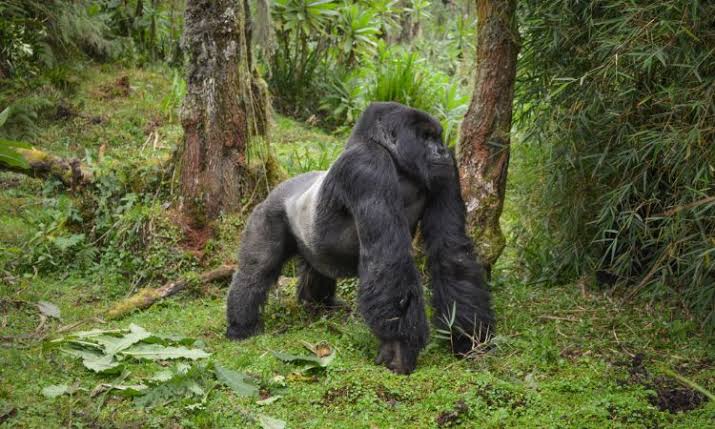
The silverback — so named for the patch of silver fur across his back once he reaches maturity — holds near-exclusive mating rights within his group. This polygynous system, where a single male mates with multiple females, shapes nearly everything about gorilla mating dynamics.
A fully grown silverback’s size and weight — up to 270 kg — is itself part of the story, since his bulk and strength are what secure and defend that mating position in the first place.
The silverback maintains dominance through chest-beating displays and vocalizations that deter rival males, and these same displays double as courtship signals, showing females his fitness as a mate.
This hierarchy is central to understanding gorilla mating positions, because the structure of the troop directly shapes which behaviors researchers actually observe in the wild.
Female Initiation of Mating
Unlike many mammal species where males initiate mating, female gorillas often take the lead. When in estrus, a female signals readiness through prolonged eye contact, lip-pursing, or ground-slapping to get the silverback’s attention.
If he doesn’t respond, she may approach a subordinate male instead — a flexibility in gorilla mating strategy that’s well documented among the Bwindi gorilla families tracked by conservationists.
Primary Gorilla Mating Positions
Gorilla mating positions are shaped by anatomy, social structure, and reproductive goals. Two positions dominate the research record: the common dorso-ventral (rear-entry) position, and the much rarer ventro-ventral (face-to-face) position.
Dorso-Ventral (Rear-Entry) Position
The dorso-ventral position is by far the most common gorilla mating posture. The female assumes a quadrupedal stance, kneeling on all fours with her rear presented to the male, a posture that signals receptivity and gives the pair stability.
The male — typically the dominant silverback — mounts from behind, bracing on her back or sides, often inspecting her genital area briefly before copulation begins.
The act itself is brief, usually one to five minutes, reflecting how strongly gorilla mating is driven by reproduction rather than prolonged interaction.
This position appears across all gorilla subspecies — western lowland, eastern lowland, mountain, and cross-river gorillas alike — largely because it accommodates the significant size difference between males and females. It’s also common across many other mammal species, which makes it a useful reference point whenever people compare gorilla mating behavior with that of other primates.
Ventro-Ventral (Face-to-Face) Position
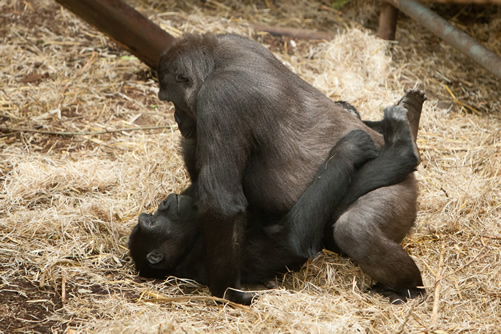
Far rarer, but well documented, is face-to-face mating — a behavior once thought unique to humans and bonobos. Researchers first photographed wild western lowland gorillas mating face-to-face in 2008 in Nouabalé-Ndoki National Park, Republic of Congo.
Mountain gorillas have also been observed adopting this position, though it’s never been captured on camera in the wild for that subspecies.
In this posture, the female lies on her back while the male positions himself above her — a more physically demanding arrangement given his size, which is part of why it’s uncommon.
Face-to-face mating in gorillas is thought to carry social significance beyond reproduction, sometimes strengthening bonds with the silverback or reflecting behavioral flexibility that echoes what’s seen in bonobos.
What Influences Gorilla Mating Positions
Biological and Anatomical Factors
Gorillas show extreme sexual dimorphism: males can weigh up to 270 kg (600 lb), while females average around 100 kg (220 lb).
That gap explains why the dorso-ventral position dominates — it lets the larger male mount without injuring the female, while her quadrupedal stance keeps her stable throughout.
The rarer face-to-face position may be possible at all because of gorillas’ close genetic relationship to humans, even though the male’s size makes it impractical in most encounters.
Social Dynamics and Group Structure
In single-male troops, the silverback’s exclusive mating rights mean nearly all copulation happens with him, usually via the dorso-ventral position for its efficiency.
In multi-male groups — roughly 40% of mountain gorilla troops — subordinate males sometimes mate with females too, occasionally producing more face-to-face encounters, especially involving subadult females.
Female choice plays a role as well: in troops with more than one male, a female may favor a particular position or partner, a dynamic researchers tie closely to gorilla social structure and mate selection.
Reproductive Stage and Estrus
Female gorillas reach sexual maturity between 10 and 12 years old, though ovulation can begin as early as age six. Their estrus cycle runs 30 to 33 days, with just a one- to two-day fertile window.
Unlike chimpanzees, female gorillas show only subtle signs of estrus — slight swelling or reddening — which males detect through close inspection.
During estrus, the dorso-ventral position tends to dominate for its efficiency; outside of estrus, mating sometimes still occurs to reinforce social bonds, occasionally involving the rarer face-to-face position.
How Gorilla Mating Compares to Other Primates
Bonobos: The Face-to-Face Specialists
Bonobos use ventro-ventral mating far more often than gorillas do, and not just for reproduction — it plays a role in social bonding and conflict resolution within their more egalitarian troops. That contrast is exactly why face-to-face mating stands out as unusual whenever it’s documented in wild gorillas.
Chimpanzees: Visible Estrus, Opportunistic Mating
Chimpanzees also favor the dorso-ventral position, but their estrus is far more visible — pronounced genital swelling signals fertility to the whole troop, and multiple males often mate opportunistically with the same female.
That’s a sharp contrast to the tightly controlled, silverback-led mating access typical of gorilla troops. Anyone curious about the differences in more depth can dig into the gorilla vs. chimpanzee mating behavior comparison directly.
Humans: Emotional and Cultural Influences
Human mating is shaped heavily by emotional and cultural context, with face-to-face positions common as an expression of bonding. Gorilla mating, by contrast, stays largely reproductive and efficiency-driven — though the occasional appearance of face-to-face mating suggests gorillas retain some of the same evolutionary flexibility.
Evolutionary and Ecological Context
Gorilla mating positions reflect adaptation to a polygynous social structure and a forest habitat where mating typically happens on the ground. The dorso-ventral position suits uneven terrain and supports quick, efficient reproduction — important in an environment where the silverback also needs to stay alert to rivals and hold his troop together.
Face-to-face mating, while rarer and less practical outdoors, may hint at an evolutionary link to more socially complex mating behavior seen in humans and bonobos.
Mating Behavior, Gestation, and Group Dynamics
Courtship and Initiation
Female gorillas typically initiate mating through eye contact, lip-pursing, or ground-slapping during estrus, while silverbacks may initiate through displays or, occasionally, more assertive contact. These cues shape the mating position that follows, with the dorso-ventral stance the default outcome of most courtship sequences.
Gestation and Infant Care
After successful mating, a female gorilla carries her pregnancy for about 8.5 months — remarkably close to human gestation — before giving birth to a single infant weighing roughly 2 kg.
Interbirth intervals stretch 4 to 6 years, reflecting how intensive gorilla maternal care really is, which makes reproductive success and mate access critically important for the species. If you’ve ever wondered how gorilla infants are raised in the wild, our page on mountain gorilla nests covers the day-to-day family life that follows.
Infanticide and Group Dynamics
When a new silverback takes over a troop — through death or displacement of the previous leader — infanticide sometimes follows, a brutal but well-documented strategy that brings females back into estrus faster.
It’s one of the starkest examples of how competitive gorilla reproduction really is, and it shapes female mate choice going forward.
Why This Matters for Conservation
Because gorillas reproduce so slowly, understanding their mating behavior is directly tied to conservation planning. Mountain gorillas remain endangered, and research like the 2008 face-to-face mating study helps researchers understand behavioral flexibility that may matter for long-term population recovery.
For an up-to-date look at where mountain gorilla populations currently stand, see how many mountain gorillas are left in the wild today.
The Dian Fossey Gorilla Fund, one of the longest-running gorilla research and conservation organizations in the world, continues to track these populations and behaviors in the Virunga Massif.
See Gorilla Behavior for Yourself in Uganda
Reading about gorilla mating positions is one thing — watching a real troop interact in Bwindi Impenetrable Forest is another entirely. Uganda remains one of the very best places on Earth to observe mountain gorillas in their natural habitat, and our guided gorilla trekking experiences put you within meters of a habituated family, led by guides who can point out silverback displays, courtship behavior, and social hierarchy as they happen in real time.
If you want a deeper, slower encounter, our 3-day gorilla habituation experience lets you spend extended time with a family that’s still becoming accustomed to human observers — a rare chance to see gorilla behavior even researchers don’t often witness.
Whether you’re drawn by the science, the photography, or simply the chance to stand a few meters from a wild silverback, book your Uganda gorilla trek with us and see these extraordinary animals — and their fascinating social world — up close.
Related Pages
- Silverback Gorilla
- Silverback Gorilla Mating
- How Often Do Gorillas Mate
- Gorilla vs Chimpanzee Mating Behavior
- Bwindi Gorilla Families
- Are Mountain Gorillas Vegan
- Biggest Threat to Mountain Gorillas
- Gorilla Trekking for Elderly
External source: Dian Fossey Gorilla Fund International — ongoing mountain gorilla behavioral research in the Virunga Massif.

https://shorturl.fm/FIWkT
https://shorturl.fm/PBOeI
https://shorturl.fm/lPxDn
https://shorturl.fm/rTN4o
Yo, y444gamedownload is my go-to for finding those legit game downloads. No dodgy stuff, just straight-up gaming goodness. Check it out: y444gamedownload
Chơi tại netmirror thấy thao tác đơn giản và dễ hiểu. TONY09-29
Login process is very secure and quick. I love how they handle user accounts and the bonuses are actually generous. Try jili01casinologin today.