
Do Chimpanzees Eat Meat? An Intriguing Insight
Do chimpanzees eat meat? Yes — and understanding how, why, and how often makes watching them in the wild on a chimpanzee trekking safari in Uganda’s Kibale National Park even more fascinating.
Chimpanzees (Pan troglodytes), our closest living relatives, are renowned for their intelligence, complex social bonds, and surprisingly varied diet.
Often pictured munching fruit or leaves, chimpanzees are actually omnivores, eating both plant- and animal-based food — a fact that makes chimpanzee tracking in Uganda’s forests genuinely more interesting once you know what to look for.
Chimpanzees as Omnivores: A Diverse Diet
Chimpanzees are classified as omnivores, with a diet shaped by habitat, season, and food availability. Across Central and East Africa, their diet is mostly plant-based — fruit (50–80%), leaves, flowers, seeds, bark, and pith — supplemented by animal protein. Meat, including insects, small mammals, and occasionally birds or eggs, typically makes up 5–10% of a chimpanzee’s diet, though this share can rise sharply during certain seasons.
This dietary flexibility helps chimpanzees adapt to shifting food supply, and it’s exactly the kind of behavior a knowledgeable guide points out during a chimpanzee habituation experience in Kibale Forest — a troop’s feeding pattern tells you a lot about what season you’re visiting in.
Insects: A Protein-Packed Staple
Insects are the most common “meat” in a chimpanzee’s diet, with termites and ants particular favorites. Chimpanzees are famous for using tools to forage for them — inserting a stick or grass blade into a termite mound and extracting the insects that cling to it, a behavior first documented in populations like those at Tanzania’s Gombe National Park by Dr. Jane Goodall. It requires real dexterity, and young chimpanzees learn the technique by carefully watching adults.
Vertebrates: Hunting for Mammals
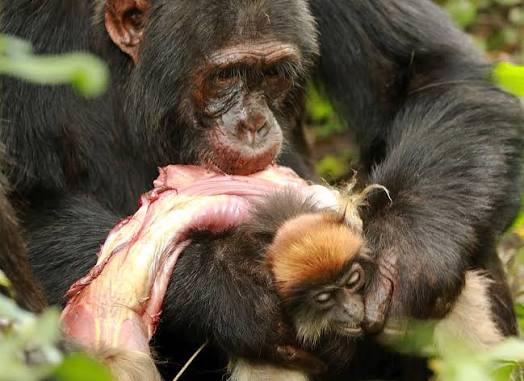
Chimpanzees are skilled, cooperative hunters, and vertebrate meat — mostly small mammals — is a prized part of the diet. The most common prey is the red colobus monkey, a favored target in East African populations, including the chimpanzees studied in Uganda’s Kibale National Park, home to the country’s most reliable chimpanzee tracking in Uganda experiences. Other prey includes bushbabies, duikers, and young baboons.
Hunting is typically led by males working in groups of 2 to 10, chasing, cornering, and capturing prey using coordinated strategies. Once caught, meat is shared among group members — a behavior that reinforces social bonds and hierarchy within the troop, and something guides in Kibale can sometimes point out evidence of on a trek, even without witnessing a hunt directly.
Why This Behavior Makes Chimpanzee Trekking More Rewarding
Understanding that chimpanzees are active hunters and tool-users — not simply fruit-eaters — changes how you watch them on a trek.
Spotting a chimp fishing for termites with a stick, or noticing scars and behavior patterns tied to a recent hunt, turns a sighting into genuine insight. Kibale National Park, often called the “primate capital of Africa,” is home to over 1,500 chimpanzees and offers some of the most reliable chimpanzee trekking in Uganda anywhere on the continent, including full-day habituation experiences that follow a community from dawn.

Where to See Chimpanzees in Uganda
Kibale National Park remains Uganda’s premier destination for chimpanzee trekking, with standard treks lasting a few hours and habituation experiences running a full day for a deeper look at social and feeding behavior.
Nearby, the Bigodi Wetland Sanctuary and Bigodi Swamp Walk make excellent afternoon add-ons, with chimpanzees from Kibale occasionally crossing into the sanctuary itself.
For travelers wanting chimpanzees alongside gorillas, our 4 Days Gorilla & Chimpanzee Tour combines both great ape experiences in one trip.
Shorter options include our 2 Days Kibale Chimpanzee Trekking Safari and 3 Days Kibale Primate Tour, while travelers based near Entebbe can visit rescued chimpanzees on our 1 Day Ngamba Island Chimpanzee Tour — home to orphaned and rescued chimps in a sanctuary setting rather than the wild.
Combine Chimpanzee Trekking With the Rest of Uganda
Chimpanzee trekking pairs naturally with Uganda’s other headline wildlife experiences. Our longer circuits, including the 21 Days Uganda Wildlife Safari and 12 Days Uganda Wildlife Safari, both feature Kibale chimpanzee tracking alongside gorilla trekking in Bwindi Impenetrable National Park and game drives in Queen Elizabeth National Park.
Travelers extending into Rwanda should browse our Rwanda-Uganda safaris collection for combined itineraries. For a broader sense of what a Uganda trip involves — where to stay, what else to see — our guides to Uganda safaris and Uganda safari lodges are worth reading before you book, and our gorilla safaris collection covers the primate side of the country in full.
Kibale’s forest is also a strong birdwatching destination, with over 370 species recorded alongside its famous chimpanzee population.
See Wild Chimpanzees for Yourself in Uganda
Reading about chimpanzee hunting and tool use is one thing — watching a troop forage, fish for termites, or care for their young in Kibale’s forest is something else entirely.
As a UWA licensed, UTB registered, and RDB accredited Uganda safari operator, we handle every detail of your chimpanzee trekking permit and itinerary, from booking through to the trek itself.
Visit us or contact us today to start planning your Uganda chimpanzee trekking safari, and see this remarkable, complex behavior firsthand.
Related Pages
- 2 Days Kibale Chimpanzee Trekking Safari
- 3 Days Kibale Primate Tour
- 1 Day Ngamba Island Chimpanzee Tour
- Bigodi Wetland Sanctuary
- Bigodi Swamp Walk
- 4 Days Gorilla & Chimpanzee Tour
- Gorilla Safaris — All Packages
- Bwindi Impenetrable National Park
- Queen Elizabeth National Park
- Uganda Safaris
- Uganda Safari Lodges
- Birdwatching in Uganda
- 21 Days Uganda Wildlife Safari
- 12 Days Uganda Wildlife Safari
- Rwanda-Uganda Safaris
- Verified Facts About Uganda Wildlife Tours
- Contact Us
For more on chimpanzee research and conservation, visit the Jane Goodall Institute directly.
https://addlinks.pro/Hqbcv