
Nile Crocodile: Size, Diet, Bite Force & Where to See Them in Uganda
Nile crocodile size, weight, bite force & diet explained. Are they endangered? Plus the real story of Nile crocodiles in Florida — and where to see them in Uganda.
The Nile crocodile is one of Africa’s most formidable apex predators, and one of the animals travelers most hope — and sometimes fear — to see up close on a boat cruise along the Nile in Murchison Falls National Park.
This guide covers everything worth knowing about the Nile crocodile: its size and weight, bite force, diet, whether it’s actually endangered, and even the strange, well-documented story of Nile crocodiles turning up in Florida.
What Is a Nile Crocodile?
The Nile crocodile (Crocodylus niloticus) is Africa’s largest crocodilian and the second-largest living reptile species on Earth, after the saltwater crocodile. Found in freshwater habitats across more than 25 African countries — including the Nile River itself, Lake Victoria, and Uganda’s own river systems — the Nile crocodile has earned a reputation as both an ecological keystone species and one of the continent’s most genuinely dangerous animals.
In Uganda specifically, Nile crocodiles are a headline sighting on boat cruises through Murchison Falls National Park, where they bask along the Victoria Nile’s banks in genuinely large numbers, and along the Kazinga Channel in Queen Elizabeth National Park.
Nile Crocodile Size: How Big Do They Actually Get?
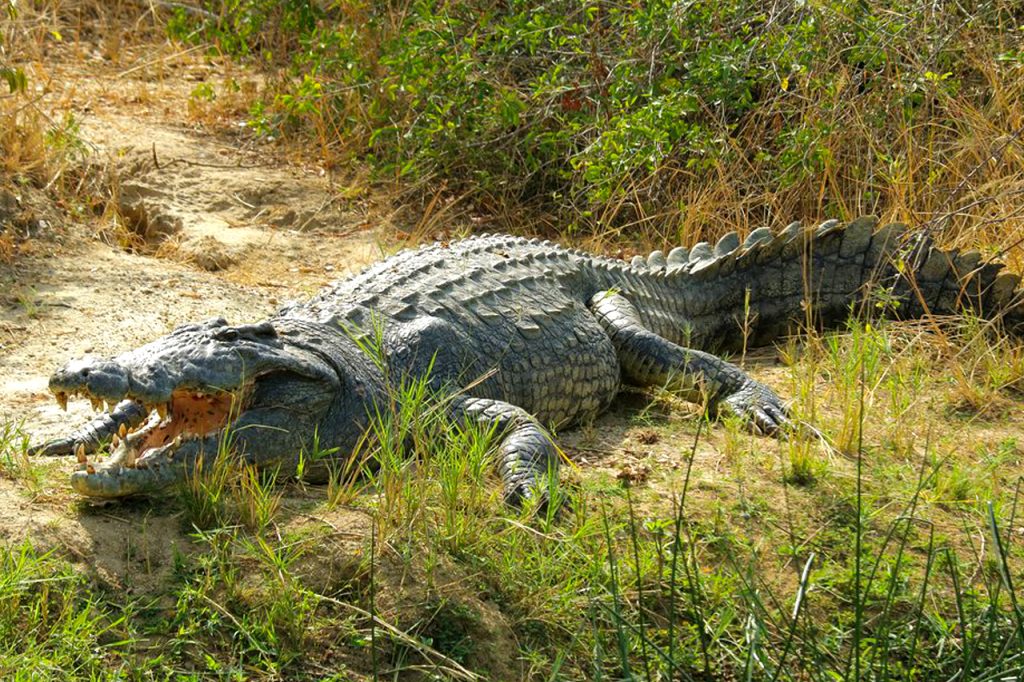
Nile crocodile size varies significantly between males and females, a trait known as sexual dimorphism. Adult males average around 5 meters (16 feet) in length, with exceptional individuals reported at up to 6 meters (nearly 20 feet) in rare cases. Females run noticeably smaller — typically 20–30% shorter than males, averaging closer to 3.5 meters.
This size makes the Nile crocodile genuinely one of the largest living reptiles, rivaled only by its Indo-Pacific cousin, the saltwater crocodile, for the title of the world’s biggest crocodilian.
How Much Does a Nile Crocodile Weigh?
How much does a Nile crocodile weigh? A large adult male typically weighs 400–500 kg (880–1,100 lbs), with exceptional specimens recorded at up to 900–1,000 kg (roughly 2,000+ lbs) — comparable to a small car. Females weigh considerably less, generally in the 150–300 kg range, reflecting their smaller overall frame.
This combination of size and weight gives the Nile crocodile the raw physical power behind its reputation as one of Africa’s most capable ambush predators — a fact made vividly clear watching one launch from the water during a Murchison Falls boat cruise or game viewing excursion.
Nile Crocodile Bite Force: How Strong Is the Bite?
Nile crocodile bite force is genuinely among the strongest measured in any living animal, with widely cited estimates placing it around 5,000 pounds per square inch (psi) — enough to crush bone effortlessly and hold prey with essentially no chance of escape once caught. For comparison, an average human bite generates roughly 150–200 psi, meaning a Nile crocodile’s bite is on the order of 25 times stronger.
That bite strength is paired with a genuinely brutal hunting technique — the crocodile clamps down and then executes a “death roll,” spinning its entire body to tear flesh or drown larger prey, a combination that makes it one of the most efficient predators in any African river system.
What Do Nile Crocodiles Eat?
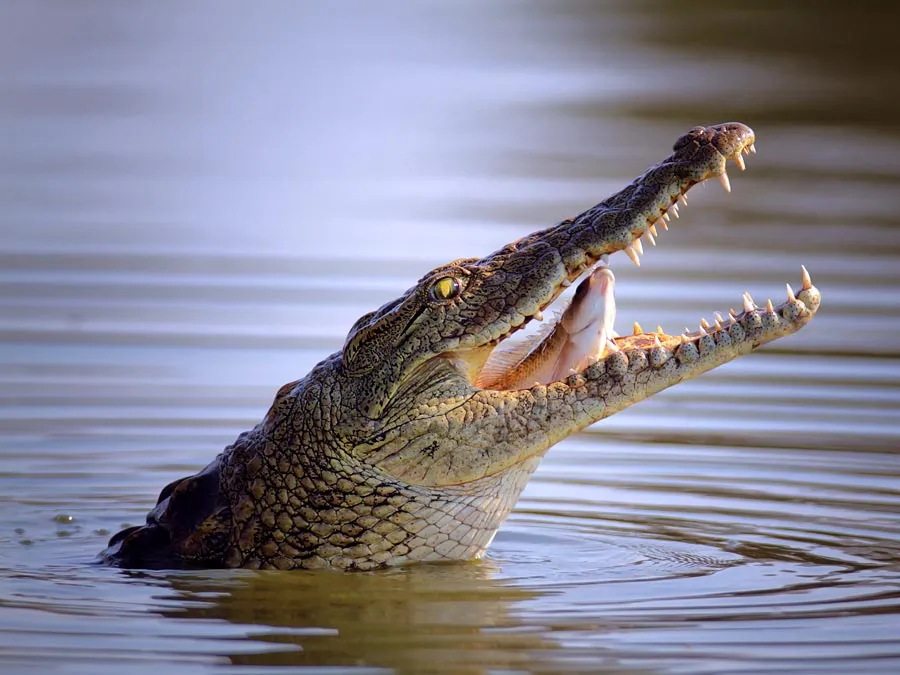
What do Nile crocodiles eat? As opportunistic apex predators, Nile crocodiles eat whatever is available and appropriately sized, adjusting their diet significantly as they grow.
Juvenile Nile crocodiles primarily eat insects, small fish, amphibians, and crustaceans, gradually shifting toward larger prey as they mature.
Adult Nile crocodiles rely heavily on fish — including catfish and tilapia — as a dietary staple, supplemented by a genuinely wide range of larger prey: wildebeest and zebra during river crossings, warthogs, antelope, and even Cape buffalo taken through coordinated ambush at water’s edge.
Birds, monitor lizards, and even smaller crocodiles (including cannibalism of juveniles by larger adults) round out what a Nile crocodile eats across its full range.
Nile crocodiles hunt primarily via ambush, lying almost entirely submerged with only their eyes and nostrils visible before exploding out of the water in a burst of speed few prey animals can escape once within striking range.
Because of their exceptionally efficient, slow metabolism, adult Nile crocodiles can go remarkably long periods — sometimes many months — between substantial meals, a genuine survival advantage during lean seasons.
Human-crocodile conflict is a real and documented issue across Nile crocodile range — the species is responsible for a significant share of the roughly 1,000 crocodile attacks reported annually across Africa, with estimates suggesting Nile crocodiles alone contribute to as many as 200 human fatalities per year, primarily among people fishing, washing clothes, or collecting water at riverbanks within the crocodile’s territory.
This is precisely why licensed guides and designated viewing points matter so much on any Uganda wildlife safari involving river or lakeside activity.
Are Nile Crocodiles Endangered?
Are Nile crocodiles endangered? No — despite their fearsome reputation, the Nile crocodile is currently classified as Least Concern on the IUCN Red List, with a global population estimated at roughly 50,000 to 70,000 mature individuals across its range.
That reassuring overall status carries real historical context worth understanding. Nile crocodiles were hunted extensively for their skins through the mid-20th century, causing severe population crashes across much of Africa.
Following international protections under CITES and the rise of regulated crocodile ranching and farming programs from the 1970s and 1980s onward, populations recovered substantially across most of the species’ range, which is exactly why the global assessment sits at Least Concern today.
That said, “Least Concern” globally doesn’t mean uniformly secure everywhere — some regional populations, including parts of South Africa, have shown real localized declines linked to water pollution, habitat loss, and human-crocodile conflict, and are assessed with greater concern at a national level even while the species as a whole remains stable.
Uganda’s own crocodile populations, including those regularly seen in Murchison Falls National Park and along the Kazinga Channel, remain healthy and well-established, making Uganda one of the most reliable places anywhere to see wild Nile crocodiles up close.
Nile Crocodile in Florida: Fact or Myth?
The phrase “Nile crocodile Florida” gets searched often enough that it’s worth addressing directly and accurately: this is a genuine, documented phenomenon, not an urban legend.
Between 2009 and 2014, three young Nile crocodiles were captured near Miami, and DNA testing conducted by University of Florida researchers, published in 2016, confirmed they were genuine Nile crocodiles genetically linked to populations in South Africa — not native American crocodiles or alligators.
Researchers believe the animals most likely entered the wild via Florida’s exotic pet trade, either escaping or being deliberately released, rather than arriving through any natural means.
Importantly, as of the most recent assessments, there is no confirmed evidence of an established, self-sustaining breeding population of Nile crocodiles in the Florida Everglades — the captured individuals appear to represent isolated introductions rather than a genuine invasive foothold.
Still, researchers have noted that Florida’s subtropical climate provides conditions the species could potentially survive and even thrive in, making ongoing monitoring a real conservation priority for wildlife officials in the state.
Nile Crocodile Habitat and Where to See Them in Uganda
Nile crocodiles thrive in slow-moving rivers, lakes, marshes, and mangrove swamps across their range, and Uganda offers some of the most reliable, accessible viewing anywhere on the continent.
Murchison Falls National Park — the boat cruise along the Victoria Nile toward the base of the falls is Uganda’s single best Nile crocodile viewing experience, with large individuals regularly seen basking on sandbanks alongside hippos and a wealth of waterbirds. Our 2 Days Murchison Falls Safari and 5 Days Gorillas & Murchison Falls Safari both include this cruise as a core activity.
Queen Elizabeth National Park — the Kazinga Channel boat cruise offers similarly strong crocodile sightings alongside hippos, buffalo, and elephants coming to drink, and our 3 Days Queen Elizabeth National Park Safari and the Ishasha sector both feature this park prominently.
Lake Mburo National Park — smaller in scale but genuinely reliable for crocodile sightings on its boat safari, alongside zebra and eland on land, covered in our broader Uganda safaris collection.
Nile Crocodile FAQ
What does a Nile crocodile eat? A genuinely broad diet ranging from fish and birds to large mammals including wildebeest, zebra, warthogs, and buffalo, captured primarily through ambush at the water’s edge.
How big is the Nile crocodile compared to other crocodiles? It’s Africa’s largest crocodilian and the world’s second-largest living reptile overall, behind only the saltwater crocodile of the Indo-Pacific region.
Is a Nile crocodile stronger than an alligator? Yes — Nile crocodiles are generally larger, heavier, and considered more aggressive than the American alligator, with a notably stronger bite force and a documented history of predating on humans, which the American alligator very rarely does.
Do Nile crocodiles live in Uganda? Yes, extensively — they’re a common and reliable sighting throughout Murchison Falls National Park, Queen Elizabeth National Park’s Kazinga Channel, and Lake Mburo National Park, making Uganda one of the best countries in Africa to see them in the wild.
See Nile Crocodiles for Yourself on a Uganda Safari
Reading about bite force and hunting technique is one thing — watching a Nile crocodile explode from stillness into a full-speed ambush along the Victoria Nile is something else entirely, and it’s exactly the kind of moment a well-guided Murchison Falls boat cruise delivers reliably.
Popular Uganda Safaris Featuring Nile Crocodiles
Browse our 2 Days Murchison Falls Safari for a focused introduction to the park, or our 5 Days Gorillas & Murchison Falls Safari if you’re combining crocodiles with mountain gorilla trekking.
Our 3 Days Queen Elizabeth National Park Safari and the dramatic Ishasha sector both offer strong crocodile sightings alongside tree-climbing lions, and our Lake Mburo National Park guide covers a smaller, more intimate wildlife circuit.
Combine Crocodiles With Uganda’s Primates
Our full Gorilla Safaris collection, including the 1 Day Gorilla Trekking Uganda and 3 Days Gorilla Trekking Safari itineraries, pair naturally with a Murchison Falls or Queen Elizabeth extension.
Our 4 Days Gorilla & Chimpanzee Tour and 2 Days Kibale Chimpanzee Trekking Safari round out Uganda’s primate side, and a stop at Bigodi Wetland Sanctuary or a 2 Days Rhino Tracking excursion make excellent additions to a broader wildlife circuit.
Birdwatching Alongside Uganda’s Crocodiles
Nile crocodiles share their riverine habitat with exceptional birdlife — our guides to birdwatching in Uganda, Mabamba Swamp, and our dedicated 5 Days Uganda Birding Tour all cover destinations where crocodile and bird sightings genuinely overlap.
For a broader sense of trip length and lodging options, our Long Uganda Safaris, Short Uganda Safaris, 9 Days Uganda Wildlife Safari, and Uganda Safari Lodges guides cover everything else worth planning around.
Book Your Uganda Safari and See Nile Crocodiles Up Close
As a UWA licensed, UTB registered, and RDB accredited Uganda safari operator, we build every itinerary — whether crocodile-focused, gorilla-focused, or a full combination — around genuinely close, safe wildlife encounters guided by experienced local teams who know exactly where these animals will be.
Visit us or contact us today to start planning your Uganda safari, and see the Nile crocodile — one of Africa’s most formidable predators — for yourself, from the safety of a guided boat cruise on the Victoria Nile.
Related Pages
- Murchison Falls National Park
- 2 Days Murchison Falls Safari
- 5 Days Gorillas & Murchison Falls Safari
- Murchison Falls Balloon Safari
- Queen Elizabeth National Park
- 3 Days Queen Elizabeth National Park Safari
- Ishasha Sector
- Lake Mburo National Park
- Birdwatching in Uganda
- Mabamba Swamp
- 5 Days Uganda Birding Tour
- Bwindi Impenetrable National Park
- Gorilla Safaris — All Packages
- 1 Day Gorilla Trekking Uganda
- 3 Days Gorilla Trekking Safari
- 4 Days Gorilla & Chimpanzee Tour
- 2 Days Kibale Chimpanzee Trekking Safari
- Bigodi Wetland Sanctuary
- 2 Days Rhino Tracking in Uganda
- Uganda Safaris
- Uganda Safari Lodges
- Long Uganda Safaris
- Short Uganda Safaris
- 9 Days Uganda Wildlife Safari
- Verified Facts About Uganda Wildlife Tours
- Contact Us


https://addlinks.pro/OKSJS