
Pangolin Fun Facts: Diet, Habitat, How Many are Left, & More
A pangolin is a scaly, toothless, ant-and-termite-eating mammal, and it holds a grim distinction: it’s the most trafficked wild mammal on Earth, with more than 500,000 pangolins seized from illegal trade between 2016 and 2024 alone.
There are eight living species, four in Asia and four in Africa, and every single one is now classified as threatened with extinction by the IUCN. Two of Africa’s four species, the giant pangolin and the white-bellied pangolin, live in Uganda, making this one of the few countries where you can genuinely hope to see one in the wild.
This guide covers exactly what a pangolin is, where they live, how many are left, and what they eat.
Pangolin Facts at a Glance
| Number of living species | 8 (4 African, 4 Asian) |
| Conservation status | All 8 species threatened (IUCN Red List) |
| Most trafficked species | White-bellied pangolin |
| Diet | Ants and termites (myrmecophagous) |
| Body covering | Overlapping keratin scales |
| Weight range | About 1.8 to 33 kg, depending on species |
| Found in Uganda | Giant pangolin, white-bellied pangolin |
| Global seizures, 2016-2024 | 500,000+ pangolins |
What Is a Pangolin?
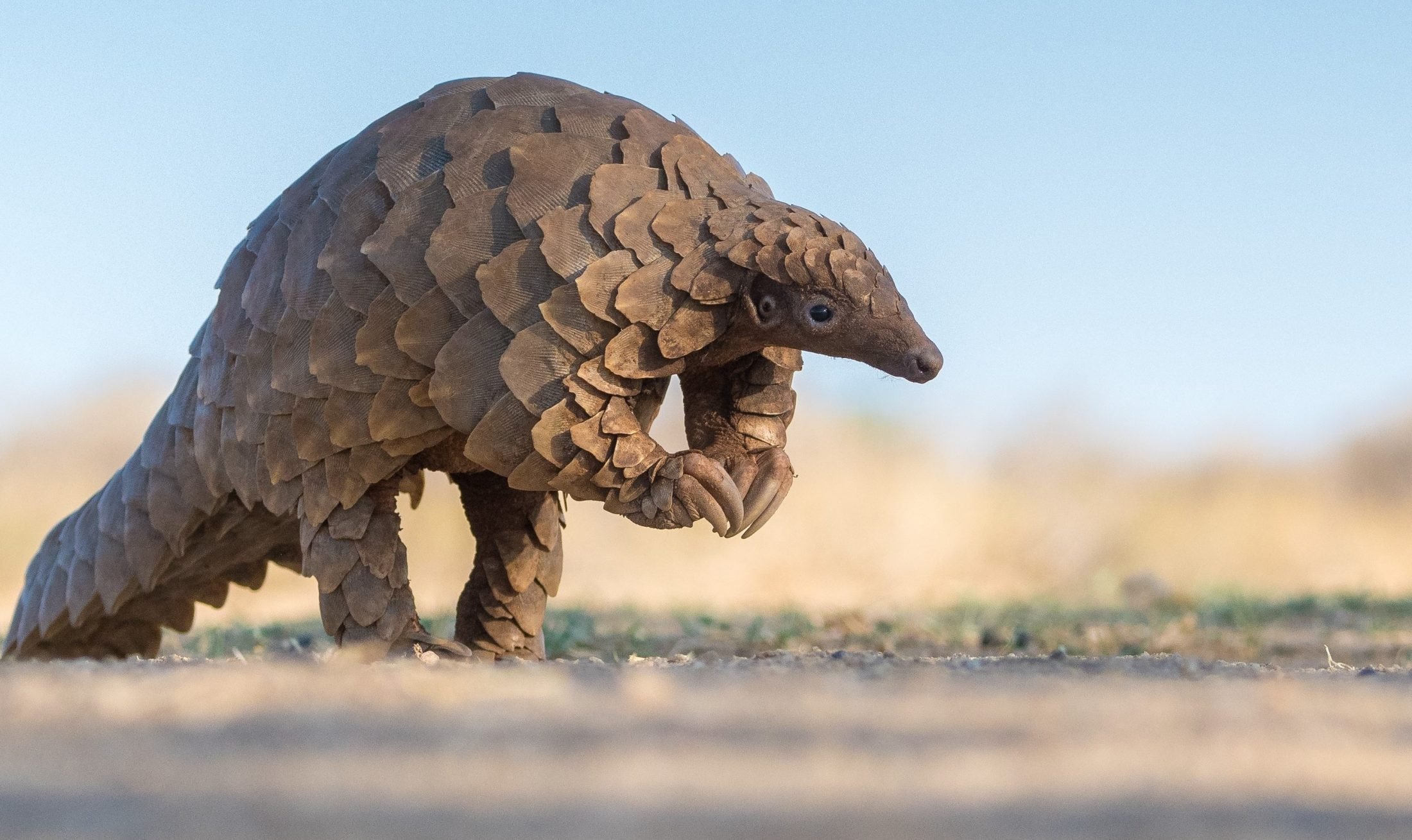
A pangolin is a shy, mostly nocturnal mammal in the family Manidae, instantly recognizable for the overlapping keratin scales that cover its entire body except its face and belly, the only mammal group with this kind of armour. Pangolin scales are made of the same protein, keratin, found in human fingernails and hair, and they make up roughly 20% of the animal’s total body weight.
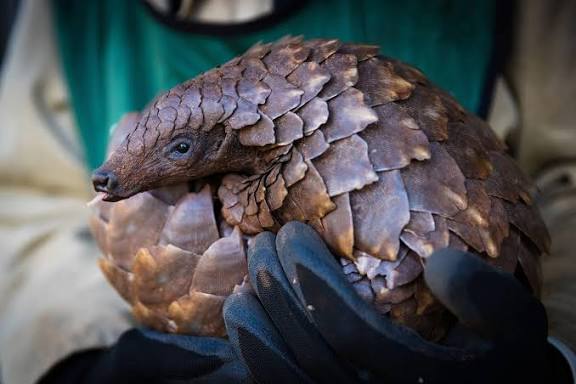
When threatened, a pangolin curls into a tight ball, scales outward, a defence effective against most natural predators like lions and leopards, but useless against a human poacher, which is a large part of why the species has become so vulnerable to hunting.
Pangolins have no teeth at all. Instead, they use an extraordinarily long, sticky tongue, in some species longer than the animal’s own body, to extract ants and termites from nests and mounds, and powerful front claws to tear open termite mounds, rotting logs, and soil.
There are eight living pangolin species: four native to Asia (Chinese, Sunda, Indian, and Philippine pangolins) and four native to Africa (giant, Temminck’s ground, white-bellied, and black-bellied pangolins).
Where Do Pangolins Live?
Pangolin habitat varies by species and continent, split roughly between ground-dwelling and tree-dwelling lifestyles:
- Giant pangolin (Smutsia gigantea): the largest of all eight species, found in forests and forest-savanna mosaics across West, Central, and parts of East Africa, including Uganda.
- Temminck’s ground pangolin (Smutsia temminckii): found in savanna and woodland across southern and East Africa.
- White-bellied (tree) pangolin (Phataginus tricuspis): the most widespread African species, arboreal, living in tropical forests across West and Central Africa, with populations extending into Uganda’s forested parks.
- Black-bellied (long-tailed) pangolin (Phataginus tetradactyla): also arboreal, restricted to the Congo Basin’s tropical forests.
- Asian species (Chinese, Sunda, Indian, Philippine): range from the forests of southern China and Southeast Asia to the Indian subcontinent and the Philippines.
Pangolins in Uganda: Uganda is home to two of Africa’s four species, the giant pangolin and the white-bellied pangolin, found in forested and savanna-forest mosaic habitats including parts of Queen Elizabeth National Park, Murchison Falls National Park, and forest reserves in the west of the country.
They’re elusive, mostly nocturnal, and never guaranteed on any single visit, but Uganda remains one of the more realistic countries in Africa to encounter one, especially on a dedicated night walk or with an experienced ranger guide.
How Many Pangolins Are Left in the World?
No precise global population figure exists for pangolins, a real gap in the science, caused partly by how solitary, nocturnal, and difficult to survey they are. What conservationists do know, from IUCN Red List assessments and global trade-seizure data, paints a stark picture:
- All eight species are classified as threatened with extinction, ranging from Vulnerable to Critically Endangered.
- The giant pangolin and white-bellied pangolin, Uganda’s two species, are both classified as Endangered.
- The Chinese, Sunda, and Philippine pangolins are Critically Endangered, the most severe threat category before extinction in the wild.
- More than 500,000 pangolins were seized from illegal trade globally between 2016 and 2024, and that figure only captures intercepted shipments, the true number trafficked is certainly higher.
- The white-bellied pangolin is the most heavily trafficked species by volume, with an estimated 80,000-plus individuals seized in trade-monitoring data during the period studied.
- Population trend: decreasing, across every one of the eight species, with no exceptions.
The core driver is the illegal wildlife trade: pangolin scales are used in traditional medicine, primarily in parts of Asia, despite having no proven medicinal properties (they’re chemically identical to keratin in human fingernails), and pangolin meat is considered a delicacy in some markets.
Habitat loss compounds the problem, particularly for forest-dependent species like the white-bellied and black-bellied pangolins.
What Do Pangolins Eat?
Pangolins are strict insectivores, specifically myrmecophagous, meaning their entire diet consists of ants and termites. A single pangolin can eat up to 70 million insects a year, making it a genuinely significant natural pest-control species within its ecosystem, one of the underappreciated ecological roles conservationists point to when explaining why their decline matters beyond the species itself.
To find food, pangolins use an acute sense of smell (their eyesight is poor) to locate ant nests and termite mounds, then tear them open with powerful, curved front claws.
Their extraordinarily long, sticky tongue, anchored deep in the chest cavity rather than the mouth, extends far past the mouth to extract insects from narrow tunnels no other predator could reach.
Since they have no teeth, pangolins swallow small stones and soil alongside their food; these help grind insects down in a muscular stomach chamber that functions much like a bird’s gizzard.
Why Pangolin Conservation Matters
Beyond their own survival, pangolins play a genuine ecological role as natural regulators of ant and termite populations, helping protect forest and savanna ecosystems from insect overpopulation.
Their decline also reflects a broader wildlife trafficking crisis: the same smuggling networks moving pangolin scales frequently traffic ivory, rhino horn, and other illegal wildlife products, making pangolin protection part of a much larger conservation and law-enforcement effort across Africa and Asia.
Seeing a pangolin responsibly, through licensed park guides on protected land rather than through captive or trade-linked tourism, directly supports the conservation economics that fund anti-poaching and habitat protection in the parks where they survive.
Our guides in Queen Elizabeth National Park and across Uganda’s forested reserves can factor a pangolin search into a night walk or general wildlife itinerary, alongside the country’s headline draws.
Pangolin FAQs
What is a pangolin closely related to? Despite looking similar to anteaters or armadillos, pangolins aren’t closely related to either. Genetically, they’re most closely related to Carnivora (the order that includes cats, dogs, and bears), making their appearance a striking example of convergent evolution rather than shared ancestry.
Are pangolins dangerous? No. Pangolins are shy, non-aggressive, and have no teeth. Their only defence is curling into a tight, armoured ball.
How many pangolin species are there? Eight: four native to Africa (giant, Temminck’s ground, white-bellied, black-bellied) and four native to Asia (Chinese, Sunda, Indian, Philippine).
Why are pangolins endangered? Primarily illegal wildlife trafficking for their scales (used in traditional medicine, despite no proven medicinal value) and meat, compounded by habitat loss for forest-dependent species.
Can I see a pangolin in Uganda? It’s possible but never guaranteed. Uganda hosts two species, the giant pangolin and white-bellied pangolin, in forested and savanna-forest habitats including parts of Queen Elizabeth and Murchison Falls National Parks. They’re elusive and mostly nocturnal, so a dedicated night walk with an experienced guide gives you the best chance.
What do pangolins eat? Exclusively ants and termites. A single pangolin can consume up to 70 million insects annually.
Which pangolin species is the most trafficked? The white-bellied pangolin, by volume, with tens of thousands of individuals estimated trafficked in recent seizure data, more than any other species.
Plan a Uganda Wildlife Safari
Uganda’s forests and savannas hold far more than gorillas and chimpanzees, from elusive pangolins to a wide range of forest and savanna wildlife.
Browse our safari packages, read our verified facts and credentials, or send us an enquiry to build an itinerary around Uganda’s full range of wildlife.