

Chimpanzee Family:Social Structure, Relationships & Behavior
A chimpanzee family is built around a mother and her offspring. Chimpanzees do not live in pairs or with a fixed father. They live in large communities of about 20 to 150 members, and sometimes over 200, which split into smaller groups during the day. Key facts about the chimpanzee family:
- Mothers raise their young alone.A mother gives birth to one infant every 5 to 6 years, nurses it for about 4 to 5 years and keeps it close until it is around 8 to 10 years old.
- Fathers play a small role.Females mate with several males, so fathers don’t raise their young. They protect the whole community instead.
- Siblings bond for life.Older siblings carry, play with and protect younger ones, and adult brothers often become allies.
- Sons stay and daughters leave.Males stay in the community they were born into for life. Most females move to a new community when they reach adolescence, at around 11 to 13 years.
- Orphans are often adopted.Older siblings and other community members, sometimes even adult males, adopt orphaned infants.
The best place to see chimpanzee families in the wild is Kibale National Park in Uganda, home to about 1,500 chimpanzees, one of the highest densities in Africa. A chimpanzee trekking permit in Kibale costs US$250, rising to US$300 from 1 January 2027.
Chimpanzees are our closest living relatives, sharing about 98–99% of our DNA. Watching a chimpanzee family gives us a unique insight into the evolution of family bonds, parenting, communication and social behavior.
This guide explains how chimpanzee families work, from mothers and fathers to siblings and orphans, and how you can watch them in the wild on a Uganda safari.
Chimpanzee Family at a Glance
| Fact | Detail |
| Core family unit | Mother and her dependent offspring |
| Community size | About 20–150 members, sometimes over 200 |
| Mating system | Promiscuous: no pair bonds or fixed partners |
| Gestation | About 8 months (around 230 days) |
| Number of young | Usually one infant; twins are rare |
| Birth interval | About 5–6 years |
| Weaning age | About 4–5 years |
| Time with mother | Until about 8–10 years, longer for sons |
| Who leaves home? | Females, at around 11–13 years |
| Lifespan in the wild | About 30–40 years, sometimes over 50 |
| Conservation status | Endangered (IUCN) |
1. Chimpanzee Social Structure: Community, Party and Family
Chimpanzee society works on three levels.
The community. Chimpanzees live in communities of about 20 to 150 individuals. Some are much larger: the Ngogo community in Kibale National Park, Uganda, grew to around 200 chimpanzees, one of the largest ever studied. Members share and defend a home range, and males patrol its borders. Read about the chimpanzee “civil war” in Uganda, when the Ngogo community split in two.
The party. Chimpanzees live in a fission-fusion society. The whole community is rarely together in one place. Instead, it splits into small, changing groups called parties to travel, feed and rest, then joins up again. A party might be a few males on patrol, a group feeding in a fruiting fig tree or a mother travelling quietly with her young.
The family. Within the community, the real family unit is a mother and her offspring. There is no “nuclear family” with a mother, father and children as in human societies, and chimpanzees don’t form pairs. A mother usually travels with her dependent infant and often an older juvenile, and the family stays close for many years.

2. The Role of Mothers in Chimpanzee Families
The mother is at the center of every chimpanzee family, and the mother-offspring bond is the most important relationship in a chimpanzee’s life.
Pregnancy and birth. A female chimpanzee usually has her first baby at around 13 to 15 years old. After a pregnancy of about 8 months, she gives birth to a single infant, weighing about 1.5–2 kg. Learn more about facts about chimpanzees.
Carrying and nursing. For the first few months, the newborn clings to its mother’s belly. From about 5 to 6 months old, it begins riding on her back. The infant nurses for about 4 to 5 years and sleeps with its mother in her tree nest each night.
A long childhood. Even after weaning, young chimpanzees stay close to their mothers until they are about 8 to 10 years old. Because mothers invest so much in each infant, they give birth only about once every 5 to 6 years. This makes chimpanzee populations slow to recover from losses. Read more in our guide Are chimpanzees endangered?
Teaching survival skills. Young chimpanzees learn by watching their mothers closely. They learn:
- Which foods to eat, including fruits, leaves, insects and sometimes meat. See do chimpanzees eat meat?
- How to use tools, such as fishing for termites with sticks, cracking nuts with stones and using chewed leaves as sponges to drink water. Studies at Gombe in Tanzania found that daughters often watch and copy their mothers more closely than sons do.
- Where to find foodacross the forest in different seasons.
- How to behave socially: whom to greet, groom, respect or avoid.
Lifelong importance. A mother’s support matters even after her offspring grow up. Long-term studies have shown that young chimpanzees who lose their mothers, even after weaning, are less likely to survive. Adult sons with living mothers also tend to have more offspring of their own.
3. The Male Role: Fathers and Protectors
Chimpanzee fathers are very different from human fathers.
No fixed partners. Female chimpanzees mate with several males when they are in estrus, which they signal with a large pink swelling. High-ranking males father many infants, but paternity is shared across the community. As a result, males don’t form pair bonds or raise their own offspring, and the mother does all the direct care.
Protecting the community, not one family. Males protect all the mothers and infants in their community. They defend the home range against rival communities, patrol borders and drive off threats. These patrols matter, because attacks between neighbouring communities can be deadly, especially for infants.
Do fathers know their young? Researchers once thought males couldn’t recognize their offspring. Studies at Gombe now suggest that fathers spend more time near their own infants than near other infants. This may help protect them. However, fathers still don’t carry, feed or raise their young.
Male hierarchy and alliances. Males compete for rank, and the top male is called the alpha male. Males form alliances, groom each other and sometimes share meat after a hunt to win support. Rank affects which males mate most often. It doesn’t make the alpha male the head of a family.
Mother and son. Because sons stay in the community for life, the strongest bond in a male’s life is often with his mother. A mother may support her son in conflicts, even when he is an adult.
4. Chimpanzee Siblings: A Lifelong Bond
Siblings share the same mother, but usually have different fathers.
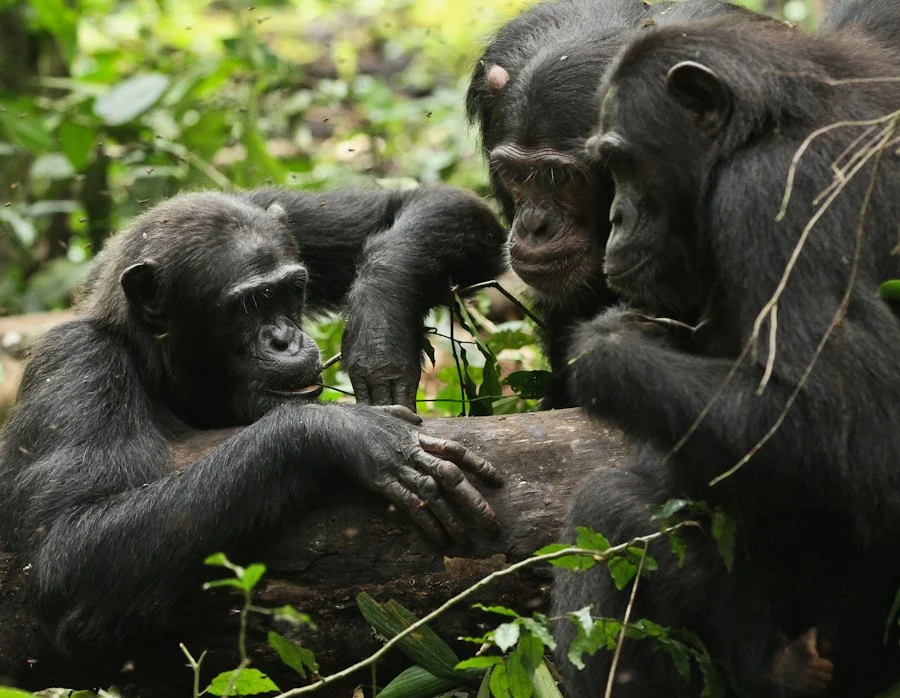
Playmates and helpers. Older siblings play with, carry, groom and protect their younger brothers and sisters. This helps the mother and teaches the older sibling how to care for infants. Juvenile females in particular often practice “babysitting” on their younger siblings.
Rivalry. Siblings can compete, especially when a new baby arrives and an older offspring is being weaned. This period can bring tantrums and attention-seeking, but young chimpanzees learn to cope and to read social signals.
Brothers as allies. Because males stay in their birth community, brothers often remain close for life. They groom each other, travel together and support each other in fights for rank.
Sisters leave home. Most females leave their birth community at adolescence to join a new one, where they mate and raise their own families. This helps prevent inbreeding, but it means that adult sisters often live in different communities and rarely see each other again.
5. Chimpanzee Communication Within Families
Chimpanzees have a rich communication system, and young chimps learn it first from their mothers and siblings.
- Vocalizations:Chimpanzees make many different calls. The loud pant-hoot keeps community members in touch across the forest. Pant-grunts are greetings that lower-ranking chimps give to higher-ranking ones. Alarm calls warn of danger, and food grunts announce a good feeding spot.
- Gestures:Researchers studying chimpanzees in Budongo Forest, Uganda, recorded around 66 different gestures with clear meanings, such as “climb on me”, “follow me” and “stop that”. Mothers use gestures to tell their infants to climb on or come close.
- Facial expressions:A relaxed “play face” invites play, while a bared-teeth “fear grin” shows fear or submission.
- Touch and grooming:Grooming is the main way chimpanzees build trust and affection. Mothers groom their infants daily, and family members groom each other for hours. Grooming also removes ticks and dirt, but its social role is just as important.
Find out how chimpanzee intelligence compares with ours in Are you smarter than a chimpanzee?
6. Adoption and Orphans: When Family Extends
When a mother dies, her orphaned infant faces a hard future, especially if it is still nursing. Chimpanzees sometimes step in to help:
- Older siblingsoften adopt their orphaned younger brothers or sisters, carrying them, sharing nests and protecting them.
- Other community memberssometimes adopt orphans too. In Taï Forest in Ivory Coast, researchers recorded orphans being adopted by unrelated adults, including adult males, who carried them, shared food and protected them for years.
Adoption shows that chimpanzee family bonds can extend beyond mothers and their own offspring, and that cooperation and care are part of chimpanzee society.
7. The Life Cycle of a Chimpanzee Family Member
| Stage | Age | What happens |
| Infant | 0–5 years | Clings to and rides on its mother, nurses and sleeps in her nest |
| Juvenile | 5–8 years | Weaned and more independent, but still travels with mother |
| Adolescent | 8–15 years | Females leave for new communities, and males start joining adult males |
| Adult | 15+ years | Females raise their own young, and males compete for rank |
| Elder | 30+ years | Older chimpanzees may lose rank but often keep strong social bonds |
Why the Chimpanzee Family Matters
Family bonds shape every part of a chimpanzee’s life. Mothers pass on survival skills and food knowledge. Siblings provide lifelong friends and allies. Males protect the community that keeps families safe. Long-term studies show that strong social bonds help chimpanzees survive and reproduce. They also show that losing a mother can affect a chimpanzee for life.
Because each mother has so few young and depends on healthy forests, chimpanzee families are very vulnerable to habitat loss, hunting and disease. Chimpanzees are listed as Endangered by the IUCN.
Responsible tourism helps protect them: permit fees fund park rangers and conservation, and support local communities living around the forests.
Where to See Chimpanzee Families in Uganda
Uganda is home to about 5,000 wild chimpanzees and is one of the best countries in Africa for chimpanzee trekking.
| Destination | Highlights |
| Kibale National Park | Around 1,500 chimpanzees and 13 primate species. It offers the highest chance of sightings in Uganda, plus full-day chimpanzee habituation. |
| Budongo Forest (Murchison Falls Conservation Area) | A large mahogany forest with habituated chimpanzees, easy to combine with Murchison Falls National Park |
| Kyambura Gorge (Queen Elizabeth National Park) | A dramatic forested gorge, the “Valley of Apes”, combined with game drives in Queen Elizabeth National Park |
| Kalinzu Forest | A lower-cost chimpanzee trekking option near Queen Elizabeth National Park |
Chimpanzee trekking in Kibale:
- Trekking permit:US$250 per person, rising to US$300 from 1 January 2027
- Chimpanzee habituation experience:US$300, rising to US$400 from 1 January 2027
- Time with the chimpanzees:1 hour on a standard trek, or most of the day on the habituation experience
- Minimum age:12 years
- Best time:The dry seasons, from June to September and December to February, have easier trails. However, chimpanzees can be seen all year. See the best time to visit Kibale Forest.
See the full UWA gorilla and chimpanzee permit price changes.
Tips for watching a chimpanzee family:
- Keep at least 8 meters away, and never come between a mother and her infant.
- Stay quiet and move slowly, especially when infants are near.
- Don’t eat, drink or use flash photography near the chimpanzees.
- Wear long sleeves, long trousers and sturdy boots, as trails can be muddy.
- Don’t trek if you have a cold or flu, because chimpanzees can catch human diseases.
Uganda Safaris to See Chimpanzee Families
Combine chimpanzee trekking with mountain gorillas and wildlife on one of these Uganda safari tours:
- 4 Days Gorilla and Chimpanzee Tour: Chimps in Kibale and gorillas in Bwindi
- 5 Days Kibale and Bwindi Gorilla Safari: A relaxed primate safari
- 7 Days Uganda Primate Safari: Chimps, gorillas, golden monkeys and more
- 7 Days Uganda Wildlife Safari: Primates plus game drives and a boat cruise
- 10 Days Uganda Safari: The complete Uganda primate and wildlife adventure
Compare chimpanzee and gorilla family life in our guides to baby gorillas, facts about mountain gorillas and gorilla trekking in Uganda.
FAQs: Chimpanzee Family
What is a chimpanzee family called? Chimpanzees live in a community, also called a troop. Smaller groups that travel together during the day are called parties. The core family unit is a mother and her offspring.
How many chimpanzees are in a family? A typical family unit is a mother with one or two offspring. The wider community usually has about 20 to 150 members, and sometimes over 200.
Do chimpanzee fathers raise their babies? No. Females mate with several males, so fathers don’t raise their young. Males protect the whole community instead.
How long do baby chimpanzees stay with their mothers? Infants nurse for about 4 to 5 years and stay close to their mothers until about 8 to 10 years old. Sons often keep a close bond with their mothers for life.
Do chimpanzees stay with their family for life? Males do, as they stay in their birth community. Most females leave at adolescence to join a new community.
How many babies does a chimpanzee have? Usually one infant at a time, about every 5 to 6 years. A female may raise only around 4 to 6 offspring in her lifetime.
Do chimpanzees adopt orphans? Yes. Older siblings and sometimes unrelated adults, including adult males, adopt orphaned infants.
Where is the best place to see chimpanzee families in Uganda? Kibale National Park is the best place to see chimpanzee families in Uganda, with around 1,500 chimpanzees and high sighting success. Budongo Forest and Kyambura Gorge are other good options.
Conclusion
The chimpanzee family is centered on the deep, long-lasting bond between a mother and her offspring. Siblings support each other through life, and males protect the wider community.
Sons stay home for life, while daughters leave to start families elsewhere. Orphans are sometimes adopted by relatives or even unrelated adults. These close bonds help explain why chimpanzees, our closest living relatives, are among the most fascinating animals on Earth.
See a chimpanzee family in the wild. There’s no better way to understand chimpanzee family life than watching mothers, infants and playful juveniles in the forests of Kibale. Contact Uganda Wildlife Tours to plan your chimpanzee trekking and gorilla safari in Uganda, or browse our latest Uganda safari deals.


Riva su kaçak tespiti İstanbul su kaçağı tespiti: İstanbul’daki su kaçakları için profesyonel ve hızlı çözümler sunuyoruz. https://twittx.live/ustaelektrikci
Гама Казино Скачать на Андроид. https://github.com/sewer80/gamma
This website, you can access a great variety of online slots from leading developers.
Visitors can enjoy classic slots as well as modern video slots with high-quality visuals and bonus rounds.
Even if you’re new or an experienced player, there’s always a slot to match your mood.
money casino
The games are available 24/7 and designed for desktop computers and tablets alike.
All games run in your browser, so you can get started without hassle.
Platform layout is easy to use, making it convenient to find your favorite slot.
Sign up today, and discover the excitement of spinning reels!
Here offers a large assortment of home wall-mounted clocks for your interior.
You can explore urban and vintage styles to fit your apartment.
Each piece is hand-picked for its design quality and functionality.
Whether you’re decorating a creative workspace, there’s always a perfect clock waiting for you.
small digital electric desk clocks
The collection is regularly refreshed with exclusive releases.
We care about customer satisfaction, so your order is always in good care.
Start your journey to better decor with just a few clicks.
Visit the official Telegram website, choose the appropriate operating system such as Windows, macOS, Android, iOS, etc., and download the application. Enjoy seamless communication across devices with Telegram’s secure and fast messaging features, including text, voice calls, and file sharing, all backed by end-to-end encryption for enhanced privacy.telegram
I’ve been messing around on jogabet and it’s not bad at all! A decent place to kill some time. Give it a shot if you’re bored. You might get hooked. Learn more here: jogabet
F68vip is the real deal! It’s where all the high rollers are playing. Join the VIP club and experience the difference. Check it out you won’t regret it!: f68vip
Feeling lucky? Gave Lucky99game a try. It’s got a decent selection of games. I’m not ready to say I’ve won big here yet, but I’m keeping an eye on it! Explore here: lucky99game
Mình hay chơi trên điện thoại nên đánh giá cao 888slot vì hoạt động khá mượt trên mobile. TONY09-29
Mình đánh giá cao picasso vì tốc độ tải game nhanh. TONY10-09