
6 Days Rwenzori Mahoma Loop Trek 2026 — Full Itinerary, Trail Guide & Everything You Need to Know
The 6 days Rwenzori Mahoma Loop trek is Uganda’s most accessible and rewarding multi-day mountain hiking experience — a circular trail through the lower and mid-altitude zones of the Rwenzori Mountains National Park, a UNESCO World Heritage Site on Uganda’s border with the Democratic Republic of Congo.
Unlike the gruelling Rwenzori summit route to Margherita Peak at 5,109 metres, the Mahoma Loop Trek is designed for fit trekkers who want a genuine high-altitude wilderness experience without the technical mountaineering demands of the summit.
Over six days, the Mahoma Loop passes through equatorial rainforest, heather moorland, spectacular bog gardens, and the hauntingly beautiful Mahoma Lake — all while delivering close encounters with Rwenzori-endemic birds, giant lobelias, tree heathers, and the extraordinary afro-alpine vegetation that makes the Mountains of the Moon unlike anywhere else on earth.
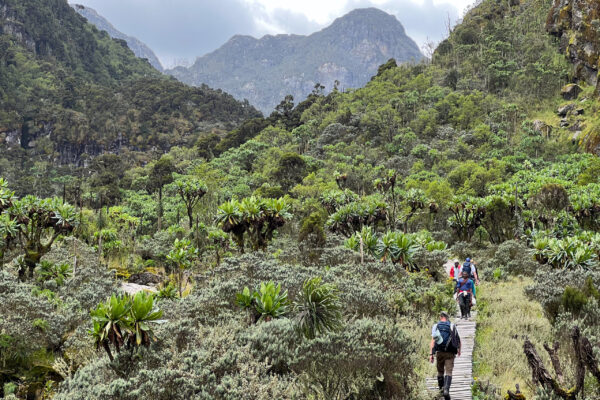
Rwenzori Mahoma Loop Trek — At a Glance
| Detail | Information |
| Trek Name | Rwenzori Mahoma Loop Trek (also called the Mahoma Circuit) |
| Duration | 6 days / 5 nights on the mountain |
| Total Distance | Approximately 55–60 km circular route |
| Highest Point | Mahoma Lake — approx. 3,700 metres above sea level |
| Starting Point | Nyakalengija Trailhead, Kasese District, western Uganda |
| Trek Type | Loop (returns to same trailhead — no shuttle required) |
| Difficulty | Moderate to Strenuous — steep ascents, boggy terrain, high altitude |
| Best Season | June–August and December–February (dry seasons) |
| Park Entry Fee | USD $40 per person per day (payable to Uganda Wildlife Authority) |
| Guide Required | Yes — mandatory UWA-certified mountain guide |
| Porter Service | Available and strongly recommended — approximately $15–20/day |
| Start City | Kampala or Entebbe (6–7 hours drive to Kasese) |
Book this trek fully guided with Uganda Wildlife Tours: 6-Day Rwenzori Mahoma Loop Trek — permits, guides, porters, and lodge transfers all arranged. →
About the Rwenzori Mountains — Africa’s Mountains of the Moon
The Rwenzori Mountains are one of Africa’s most extraordinary and least-visited natural wonders. Rising to 5,109 metres at Margherita Peak on Mount Stanley, the Rwenzoris are the highest mountain range in Africa after Kilimanjaro and Mount Kenya — and the only major equatorial mountain range in Africa that is permanently snow-capped and glaciated.
The Greek geographer Ptolemy called them the ‘Mountains of the Moon’ in the 2nd century AD, believing them to be the source of the Nile — and modern science has confirmed that the Rwenzoris are indeed a primary water source for the Nile River system through their glacial melt and rainfall drainage.
Rwenzori Mountains National Park was declared a UNESCO World Heritage Site in 1994 and an IUCN Category II protected area, recognising the extraordinary ecological diversity of its vegetation zones.
As you climb through the Rwenzoris on the Mahoma Loop Trek, you pass through five distinct vegetation zones in sequence — montane forest, bamboo zone, heather zone, afro-alpine moorland, and the surreal giant groundsel and giant lobelia zone — each with its own distinct plant communities, birdlife, and atmosphere.
The Rwenzori Mahoma Loop Trek traverses three of these zones, delivering an unforgettable sampling of this botanical wonderland without requiring glacier equipment or technical mountaineering experience.
| 🌿 Rwenzori Biodiversity: The Rwenzori Mountains are home to 70 mammal species, 217 bird species (including 19 Albertine Rift endemics such as the Rwenzori turaco, handsome francolin, and Rwenzori nightjar), and over 1,000 plant species — many found nowhere else on earth. The giant heather trees (Erica arborea) on the Mahoma Loop can reach 10 metres in height, draped in old man’s beard lichen that gives the high mountain zones their ghostly, primeval atmosphere. |
For a longer Rwenzori mountaineering experience, see the 7-Day Rwenzori Mountaineering Safari — the summit route to Margherita Peak for experienced high-altitude trekkers. →
6 Days Rwenzori Mahoma Loop Trek: Brief Itinerary
- Day 1 — Kampala to Kasese (travel and gear briefing)
- Day 2 — Nyakalengija to Sine Camp (rainforest ascent)
- Day 3 — Sine Camp to Mahoma Lake (the big day — bamboo, heather, moorland, lake)
- Day 4 — Mahoma Lake exploration and descent to Kiharo (sunrise, birding, waterfalls)
- Day 5 — Kiharo to Kyanyabutono (ridge traverse, botanical interest, wildlife)
- Day 6 — Trek out and return to Kasese (colobus, bird chorus, porter ceremony)
6 Days Rwenzori Mahoma Loop Trek — Full Day-by-Day Itinerary
The Mahoma Loop Trek follows a clockwise circuit through the central Rwenzori valleys, ascending through forest and heather zones to the jewel of the trek — Mahoma Lake — before descending back through alternate valleys to the trailhead. Here is the complete daily itinerary:
DAY 1 — KAMPALA / ENTEBBE TO KASESE — TRAVEL AND ARRIVALDrive: 6–7 hours | Altitude: 975m (Kasese) | Overnight: Kasese town lodge |
Your 6-day Rwenzori Mahoma Loop Trek begins with an early morning departure from Kampala or Entebbe by private 4WD transfer vehicle. The drive west through Uganda’s fertile rolling hills takes 6 to 7 hours, passing through Fort Portal — Uganda’s mountain town — and descending into the Kasese District at the base of the Rwenzori range.
As you arrive in Kasese on a clear day, the snow-capped peaks of the Rwenzoris are visible above the clouds to the west — a first thrilling glimpse of the mountains you will enter the following morning.
Arrive in Kasese by early afternoon to allow time for trekking gear inspection, permit and park documentation review with your Uganda Wildlife Tours guide, and a briefing on the Mahoma Loop route, safety protocols, porter introductions, and weather expectations. Overnight at a comfortable guesthouse or lodge in Kasese town. Dinner and rest — an early start awaits on Day 2.
- Route: Drive Kampala/Entebbe → Fort Portal → Kasese (6–7 hours)
- Activities: Gear check, permit confirmation, porter and guide briefing
- Overnight: Kasese town guesthouse — basic to mid-range accommodation
- Meals: Dinner at lodge included
DAY 2 — NYAKALENGIJA TRAILHEAD TO SINE CAMPDistance: ~10 km | Ascent: 950m | Altitude: 975m → 1,925m | Walking: 5–6 hours | Overnight: Sine Camp hut |
After an early breakfast, transfer by vehicle from Kasese to the Nyakalengija Trailhead (975m) — the official gateway to Rwenzori Mountains National Park and the starting point for all Mahoma Loop trekkers. Here you meet your UWA mountain ranger, receive your final trek briefing, register at the park gate, and set off into the Rwenzori equatorial rainforest.
The first day of the Rwenzori Mahoma Loop Trek is all about the forest. The trail climbs steadily through dense montane rainforest on the Mubuku Valley path, ascending the valley’s eastern slope through a green tunnel of giant ferns, African mahogany, fig trees, and hanging orchids.
The air is warm, humid, and richly scented — the smell of deep, undisturbed forest. Rwenzori turaco and Handsome Spurfowl call from the canopy overhead, and blue monkeys move through the treetops as you gain altitude.
After a stream crossing and a steep push through increasingly mossy forest, you emerge at Sine Camp (1,925m) in the late afternoon — a basic mountain hut set in a clearing with the first open views of the Rwenzori ridgeline above.
Your porters will have arrived ahead of you with supplies and will prepare hot food and tea as you rest and dry out by the camp fire. The temperature drops sharply at dusk — have your fleece and sleeping bag accessible.
| ⛰️ Trail Tip — Day 2: The first day of the Mahoma Loop involves the steepest net ascent of the trek. Take it slowly, drink 2–3 litres of water, eat at the stream crossing rest point, and let your guide set the pace. Altitude headaches that begin here are almost always resolved by rest and hydration — inform your guide immediately if symptoms persist. |
- Morning: Trailhead registration, final gear check, porter loading
- Trek Highlights: Montane rainforest ascent — giant ferns, orchids, Rwenzori turaco, blue monkeys
- Key Challenge: Stream crossing and steep forest push to Sine Camp
- Overnight: Sine Camp mountain hut (1,925m) — shared bunk accommodation
- Meals: Packed lunch on trail; hot dinner at camp
DAY 3 — SINE CAMP TO MAHOMA LAKE CAMPDistance: ~9 km | Ascent: 1,775m | Altitude: 1,925m → 3,700m | Walking: 6–8 hours | Overnight: Mahoma Lake Camp hut |
Day 3 of the Rwenzori Mahoma Loop Trek is the most dramatic and physically demanding day of the entire route — a sustained 1,775-metre ascent from Sine Camp through the bamboo zone, giant heather forest, and afro-alpine moorland to the crowning jewel of the trek: Mahoma Lake at approximately 3,700 metres above sea level.
Leaving Sine Camp at first light, the trail climbs out of the lower montane forest and enters the bamboo zone — a dense corridor of African highland bamboo that filters the morning light into shifting green columns.
Chimpanzees inhabit this bamboo zone and their dawn calls are one of the most atmospheric sounds of the entire Mahoma Loop. Beyond the bamboo, the forest transitions to giant heather (Erica arborea) — twisted, moss-draped trees that grow to 10 metres on the Rwenzori slopes, draped in old man’s beard lichen that gives the zone its ghostly, prehistoric character.
At around 3,000 metres, the heather forest gives way to open afro-alpine moorland — a landscape of giant groundsels (Senecio), giant lobelias, and tussock grass that belongs to a different geological age.
The views open dramatically in all directions: the Rwenzori ridgeline above, the Kasese plain far below, and on a clear day, the shimmer of Lake George to the east.
The final push to Mahoma Lake climbs through boulder-strewn moorland before the lake appears — a dark, mirror-still tarn cupped in a natural rock basin at 3,700 metres, surrounded by giant lobelias and trailing cloud.
Mahoma Lake is one of the most beautiful high-altitude locations in all of East Africa. The camp hut sits directly above the lake shore, and in the late afternoon the surrounding ridgeline is reflected in the water with extraordinary clarity.
Temperatures at Mahoma Lake drop to 2–5°C at night — your warmest sleeping bag layers are essential. Hot soup and a cooked meal from your porter-cook restore the energy burned on this extraordinary ascent.
| ⚠️ Altitude Reminder: Mahoma Lake sits at approximately 3,700 metres. Some trekkers experience mild altitude sickness symptoms here — headache, nausea, reduced appetite, disturbed sleep. These are normal at this elevation. Rest, hydrate, and eat even if appetite is low. Descend immediately if symptoms worsen. Your guide carries a basic first aid kit and has mountain rescue radio communication. |
- Vegetation Zone 1: Bamboo zone — dawn chimpanzee calls, bamboo corridors, forest birds
- Vegetation Zone 2: Giant heather forest — Erica arborea to 10m, old man’s beard lichen, misty atmosphere
- Vegetation Zone 3: Afro-alpine moorland — giant groundsels, giant lobelias, open Rwenzori ridge views
- Overnight: Mahoma Lake Camp hut (3,700m) — most dramatic campsite of the trek
- Meals: Packed lunch on trail; hot dinner and hot drinks at Mahoma Lake Camp
DAY 4 — MAHOMA LAKE — EXPLORATION DAY AND DESCENT TO KIHARO CAMPDistance: ~8 km | Descent: 1,100m | Altitude: 3,700m → 2,600m | Walking: 5–6 hours | Overnight: Kiharo Camp hut |
Day 4 begins with the reward of a Mahoma Lake sunrise — one of the great wild moments of any Uganda trekking experience. Wake before dawn and watch the first light touch the Rwenzori ridgeline above the lake, turning the water from black to silver to vivid blue as the sun climbs. Giant lobelias stand motionless in the early mist like sentinels from a prehistoric world.
After breakfast, allow time for a morning exploration walk around the Mahoma Lake shoreline — searching for Rwenzori-endemic bird species including the striking Rwenzori double-collared sunbird, the alpine chat, and the scarlet-tufted malachite sunbird that feeds on the giant lobelia flowers at the lake edge.
This birdwatching opportunity at Mahoma Lake is one of the finest high-altitude birding experiences in Uganda and should not be rushed.
By mid-morning, the trek resumes with the descent from Mahoma Lake into the western Mahoma Valley — a completely different descent route from yesterday’s ascent, giving the Mahoma Loop Trek its defining circular character.
The path drops steeply through heather moorland and then re-enters forest, following the Mahoma River downstream through increasingly lush vegetation.
Waterfalls cascade from the valley walls, and the sound of rushing water accompanies the entire afternoon descent to Kiharo Camp at 2,600 metres.
- Morning Highlight: Mahoma Lake sunrise — most photographed moment of the trek
- Birding Focus: Rwenzori endemic bird search: double-collared sunbird, alpine chat, malachite sunbird
- Afternoon Trek: Descent via Mahoma Valley — waterfalls, river crossings, heather to forest transition
- Overnight: Kiharo Camp hut (2,600m) — valley floor camp, warmer night temperatures than Mahoma Lake
- Meals: Packed lunch at lake; hot dinner at Kiharo Camp
DAY 5 — KIHARO CAMP TO KYANYABUTONO CAMP VIA BUJUKU VALLEY RIDGEDistance: ~12 km | Mixed terrain | Altitude: 2,600m → 2,850m | Walking: 6–7 hours | Overnight: Kyanyabutono Camp |
Day 5 is the longest day of the Rwenzori Mahoma Loop Trek in terms of distance, traversing the connecting ridge between the Mahoma Valley and the Kyanyabutono area via a series of forested ridges and valley crossings that reveal the Rwenzori landscape in its most complex and layered form.
Leaving Kiharo Camp, the trail climbs briefly to a ridge that gives panoramic views back over the Mahoma Lake basin before descending into a secondary forest valley.
This mid-mountain terrain — between 2,400 and 3,000 metres — is some of the most botanically extraordinary on the entire Mahoma Loop, with dense stands of Rwenzori Hypericum (St John’s Wort trees), giant mosses carpeting every fallen log, and the silver-barked Rapanea tree creating a canopy unlike any lowland forest.
The trail crosses three stream gullies on wooden log bridges before the final afternoon push to Kyanyabutono Camp at 2,850 metres. Rwenzori three-horned chameleons — extraordinary in their prehistoric appearance — are commonly seen on this section of the trail.
L’Hoest’s monkeys, red forest duikers, and the occasional giant forest hog are also regularly encountered by trekking groups on the Day 5 traverse. Kyanyabutono Camp offers a cosy mountain hut in a forest clearing, with a small stream nearby for washing and water collection.
| 📷 Photography Tip — Day 5: The ridge views on the morning of Day 5 offer the best wide-angle Rwenzori panoramic photography of the entire trek — bring your widest lens and shoot in the first 90 minutes after leaving Kiharo before cloud builds. The Rwenzori peaks are almost always in cloud by 10 AM. |
- Morning Highlight: Ridge panoramic views over Mahoma Lake basin — best Rwenzori vista of the trek
- Botanical Interest: Rwenzori Hypericum forest, giant mosses, silver Rapanea tree canopy
- Wildlife Watch: Rwenzori three-horned chameleon, L’Hoest’s monkey, red forest duiker, giant forest hog
- Overnight: Kyanyabutono Camp hut (2,850m) — forest clearing, stream access
- Meals: Packed lunch on trail; hot dinner at camp
DAY 6 — KYANYABUTONO CAMP TO NYAKALENGIJA TRAILHEAD — TREK OUT AND RETURN TO KASESEDistance: ~11 km | Descent: 1,875m | Altitude: 2,850m → 975m | Walking: 4–5 hours | Overnight: Kasese or travel to Kampala |
The final day of the 6-day Rwenzori Mahoma Loop Trek brings the circuit full circle — a long but satisfying descent from Kyanyabutono Camp back down through the montane forest to the Nyakalengija Trailhead where your journey began six days earlier.
The descent follows the main Mubuku Valley trail in reverse, and the contrast with Day 2’s ascent is striking — you are now reading the forest at a completely different level of familiarity, noticing details that flew past in the effort of the upward push.
The descent drops through the mossy mid-altitude forest belt and then into the lower rainforest where giant ferns and flowering epiphytes flank the trail on both sides.
Black-and-white colobus monkeys are frequently seen on this lower forest section, and the dawn chorus of Rwenzori birds — African hill babblers, Rwenzori batis, and the haunting call of the bar-tailed trogon — accompanies the morning descent.
Reaching the Nyakalengija Trailhead by mid-morning, you sign out at the UWA gate, settle outstanding payments with your porters, and receive your trek completion certificate from the park ranger.
The porter tip ceremony is a moment of genuine warmth — these extraordinary men and women carried your weight, cooked your meals, and made your Rwenzori Mahoma Loop Trek possible. Tip generously: $10–20 per porter per day is the standard recommendation and is money well spent.
From Nyakalengija, transfer back to Kasese town for a hot shower, a celebratory lunch, and the long, satisfied drive back to Kampala or Entebbe — carrying memories of a mountain world that very few visitors to Uganda ever experience.
- Morning Trek: Montane forest descent — colobus monkeys, Rwenzori birds, giant ferns
- Trailhead Arrival: UWA gate sign-out, trek certificate, porter tipping ceremony
- Afternoon: Kasese celebratory lunch; return drive to Kampala/Entebbe (6–7 hours)
- Overnight: Kampala/Entebbe hotel or home
- Meals: Breakfast at camp; celebratory lunch in Kasese
End of the 6 days Rwenzori Mahoma Loop trek.
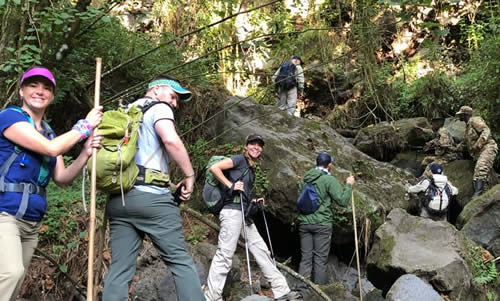
What Is Included in the Uganda Wildlife Tours 6 Days Rwenzori Mahoma Loop Trek Package
| Included Item | Details |
| All UWA Rwenzori National Park entry fees | $40 per person per day x 5 mountain days |
| UWA-certified mountain guide | Dedicated experienced Rwenzori guide throughout |
| Porter service | One porter per trekker — carrying up to 15kg of your gear |
| All mountain hut accommodation | Sine Camp, Mahoma Lake, Kiharo, Kyanyabutono (5 nights) |
| All meals on the mountain | Breakfast, packed lunch, hot dinner, tea and coffee daily |
| Camp cook | Dedicated cook prepares all hot meals and drinks at each camp |
| All surface transport | Kampala/Entebbe → Kasese → trailhead and return |
| Kasese lodge accommodation | Night 1 (arrival) and Night 6 (if required on return) |
| Trek completion certificate | Official UWA Rwenzori Mahoma Loop completion certificate |
| Emergency first aid kit | Carried by guide; satellite radio at all Rwenzori camps |
Not included: flights to Uganda, international travel insurance, personal trekking gear, alcoholic beverages, and porter tips (recommended $10–20 per porter per day).
Get a full price quote for the 6-Day Rwenzori Mahoma Loop Trek at Uganda Wildlife Tours →
Fitness Requirements and Physical Preparation for the Rwenzori Mahoma Loop Trek
The Rwenzori Mahoma Loop Trek is rated moderate to strenuous and requires a good level of cardiovascular fitness and lower-body strength. The cumulative ascent over the 6 days is approximately 3,700 metres, and trek days range from 4 to 8 hours of walking on steep, often muddy, and technically varied terrain.
Trekkers who walk regularly — at least 3–4 hours continuously on hilly terrain — and can handle altitude to 3,700 metres without significant medical concerns are well-suited to the Mahoma Loop.
In the 6–8 weeks before your trek, incorporate uphill walking or stair training into your exercise routine at least 3 times per week. Practice carrying your day pack at full weight on training hikes. If you have any cardiovascular, respiratory, or joint conditions, consult your doctor before booking — particularly regarding the altitude exposure on Days 3 and 4.
| 🥾 The Rwenzori Mahoma Loop Trek is NOT a technical mountaineering route. No glacier crossing, ice axe, crampons, or ropes are required. What you do need: waterproof boots, trekking poles, a warm sleeping bag rated to 0°C, a rain jacket, and the determination to keep moving when the mountain feels endless. The porter will carry the rest. |
Essential Packing List for the 6 Days Rwenzori Mahoma Loop Trek
Clothing
- Waterproof hiking boots — broken in before the trek; the most important item you own
- Gaiters — Rwenzori trails are notoriously boggy; gaiters prevent mud entering boots
- Lightweight rain jacket and waterproof trousers — it rains on the Rwenzori every day
- Thermal base layers (top and bottom) — essential for Mahoma Lake nights at 2–5°C
- Fleece mid-layer — worn from Day 2 onwards at altitude
- Down or synthetic insulated jacket — for evenings and mornings at Mahoma Lake Camp
- Warm hat and gloves — mandatory for Mahoma Lake nights
- Quick-dry trekking shirts (3–4) and trekking trousers (2 pairs)
- Wool or synthetic hiking socks (5 pairs minimum — your feet will get wet)
Equipment
- Trekking poles (2) — indispensable on the steep descents and boggy crossings
- Headlamp with extra batteries — the Rwenzori camps have no electricity
- Sleeping bag rated to 0°C or lower — the Mahoma Lake camp is genuinely cold
- Sleeping mat or lightweight inflatable pad if not provided by camp hut
- Dry bags or ziplock bags — protect electronics, sleeping bag, and spare clothes
- Small personal day pack (20–25 litres) — porter carries main bag; you carry essentials
- Water bottles or hydration bladder (2 litres minimum capacity)
- Water purification tablets or filter — for treating river and stream water on the trail
Health and Personal
- Personal first aid kit: blister plasters, antiseptic, pain relief, rehydration sachets
- Altitude sickness medication (Diamox/acetazolamide) — discuss with your doctor before packing
- Antimalarial medication — malaria risk in the lower forest zones of the Rwenzori
- DEET insect repellent — needed in lower forest zones; less important above 3,000m
- Sunscreen SPF 50+ — UV intensity increases dramatically at Rwenzori altitudes
- Biodegradable soap and camp towel — hot water washing available at most camp huts
- Trekking snacks: nuts, energy bars, dried fruit — supplement porter-prepared meals
- Camera — the Rwenzori Mahoma Loop is among Uganda’s most photogenic experiences
Best Time to Do the 6 Days Rwenzori Mahoma Loop Trek in Uganda
The Rwenzori Mountains receive rainfall year-round — this is one of the wettest mountain ranges in Africa — but the dry seasons offer significantly better trail conditions, clearer summit views, and a more enjoyable overall trekking experience. Here is the seasonal guide for Rwenzori Mahoma Loop Trek planning:
| Season | Months | Trail Conditions | Trekker Suitability |
| Long Dry Season (Best) | June – August | Drier trails, clearest views, coldest nights at Mahoma Lake; peak trekking season — book 2–3 months ahead | ⭐⭐⭐⭐⭐ — Ideal for first-time Rwenzori trekkers |
| Short Dry Season (Excellent) | December – February | Good trail conditions, fewer trekkers than June–Aug, excellent visibility, very cold at altitude | ⭐⭐⭐⭐⭐ — Best uncrowded Rwenzori trekking window |
| Shoulder Wet Season | September – November | Increasing rainfall, trails become muddier, beautiful lush vegetation, fewer trekkers | ⭐⭐⭐ — Manageable with right gear; best for hardy trekkers |
| Long Wet Season (Challenging) | March – May | Heavy daily rains, very boggy trails, river levels rise, reduced views; lowest prices | ⭐⭐ — Difficult; only for experienced wet-weather trekkers |
How to Combine the Rwenzori Mahoma Loop Trek with Other Uganda Safari Experiences
The Rwenzori Mountains are located in western Uganda — the same region as Queen Elizabeth National Park, Kibale Forest National Park, and within reasonable driving distance of Bwindi Impenetrable Forest.
This geographical positioning makes the Rwenzori Mahoma Loop Trek an outstanding addition to a broader Uganda wildlife safari, creating a trip that combines one of Africa’s greatest mountain treks with gorilla trekking, chimpanzee tracking, and big-game game drives.
Add a Gorilla Safari
Drive 4–5 hours south from Kasese after completing the Mahoma Loop to reach Bwindi Impenetrable Forest for mountain gorilla trekking — combining Uganda’s greatest highland trek with Uganda’s greatest wildlife encounter in a single unforgettable itinerary.
Book the 3-Day Gorilla Trekking Safari →
Add Queen Elizabeth National Park
Queen Elizabeth National Park is just 60 km from the Rwenzori Mahoma Loop trailhead. A 2–3 day extension gives you savannah game drives, the iconic Kazinga Channel boat safari, and the tree-climbing lions of Ishasha — the perfect open-plain contrast to the mountain forest world of the Mahoma Loop.
Book the 3-Day Queen Elizabeth National Park Safari →
Add Kibale Chimpanzee Trekking
Kibale Forest National Park — home to over 1,500 chimpanzees and the best chimp trekking in East Africa — is 2 hours north of Kasese. Adding a Kibale day or two before your Rwenzori trek gives your legs a warm-up and your wildlife list a spectacular early addition.
Book the 2-Day Kibale Chimpanzee Trekking Safari →
FAQs About the Rwenzori Mahoma Loop Trek
Is the Rwenzori Mahoma Loop Trek the same as the Rwenzori Summit Trek?
No. The Rwenzori summit route to Margherita Peak (5,109m) is a 7–8 day technical mountaineering experience requiring crampons, ice axes, and glacier crossing. The Mahoma Loop Trek is a 6-day non-technical circular trekking route that reaches a maximum altitude of approximately 3,700 metres at Mahoma Lake. The Mahoma Loop is accessible to fit hikers without mountaineering experience; the summit route requires technical training and specialist equipment.
Do I need a guide for the Rwenzori Mahoma Loop Trek?
Yes. A Uganda Wildlife Authority-certified mountain guide is mandatory for all trekking in Rwenzori Mountains National Park — including the Mahoma Loop. Independent trekking without a UWA guide is not permitted. Uganda Wildlife Tours provides a dedicated experienced Rwenzori guide as part of every Mahoma Loop Trek package.
What is the hardest day on the Rwenzori Mahoma Loop?
Day 3 — from Sine Camp to Mahoma Lake — is universally considered the most physically demanding day. The 1,775-metre ascent through three distinct vegetation zones over 6–8 hours of trekking is a genuine physical challenge. However, the reward — arriving at Mahoma Lake in the late afternoon — is proportionally one of the most dramatic trekking payoffs in all of Uganda.
Is the Rwenzori Mahoma Loop Trek suitable for beginners?
The Mahoma Loop is not recommended for complete hiking beginners. It requires several months of regular hill walking preparation, comfort with multi-day mountain camping, and the ability to manage mild altitude effects. Experienced recreational hikers in good cardiovascular health who have completed multi-day treks before will find the Mahoma Loop well within their reach.
How much does the Rwenzori Mahoma Loop Trek cost?
Total trek costs depend on group size, accommodation preferences, and whether you combine the trek with additional safari activities. The Uganda Wildlife Authority park fees alone total $200 per person (5 days x $40).
A fully guided package including transport, guide, porter, hut accommodation, and all meals through Uganda Wildlife Tours is priced competitively — contact us directly for a personalised quote based on your travel dates and group size.
Can I do the Rwenzori Mahoma Loop Trek without porters?
Technically yes — porters are not mandatory on the Mahoma Loop. However, we strongly recommend hiring at least one porter. The Rwenzori terrain — steep, boggy, and often slippery — is significantly harder with a heavy pack. Your porter carries your main bag, cooks your meals, and provides safety support on difficult sections. At $15–20 per day, a porter is one of the most cost-effective decisions you can make for the Mahoma Loop.
Trek the Rwenzori with Uganda Wildlife Tours — The Mountain Is Waiting
There is a specific silence that exists above the clouds in the Rwenzori Mountains. It is the silence of a place that has barely changed in 10,000 years — where giant lobelias stand like ancient torches at the lake edge, where the mist moves through heather trees that were old when explorers first wrote about these mountains in the 1880s, and where Mahoma Lake reflects a sky so blue and so close it feels like you could step into it.
The 6-day Rwenzori Mahoma Loop Trek is Uganda’s most underrated wilderness experience — less crowded than Bwindi, less commercialised than Kilimanjaro, less known than it deserves to be.
That is changing. More travelers are discovering that Uganda’s Mountains of the Moon offer a trekking experience that rivals anything in East Africa for botanical drama, altitude beauty, and the profound satisfaction of completing a circular mountain journey under your own power.
At Uganda Wildlife Tours, we have guided trekkers through the Mahoma Loop in every season and in every weather the Rwenzori can throw at a mountain. We know which camp hut has the best sunset view.
We know which porters are strongest on the Day 3 ascent. We know exactly how to pace the route so you reach Mahoma Lake with enough energy left to sit by the water’s edge and truly take in where you are.
We handle every permit, every transfer, every logistics detail — so that all you have to do is walk, look, breathe, and be astonished.
Book the 6-day Rwenzori Mahoma Loop Trek with Uganda Wildlife Tours. The Mountains of the Moon are one of Africa’s last great wild places. The time to go is now, before the glaciers finish melting and the world discovers what a handful of trekkers already know.
📞 Book the 6 Days Rwenzori Mahoma Loop Trek now: ugandawildlifetours.com/6-days-rwenzori-mahoma-loop-trek/
✉️ Contact our team for a personalised quote: ugandawildlifetours.com/contact-form/
Related Uganda Safari Experiences — Extend Your Adventure
→ 7-Day Rwenzori Mountaineering Safari — Summit Margherita Peak
→ 3-Day Gorilla Trekking Safari — Mountain Gorillas in Bwindi
→ 5-Day Kibale and Bwindi Gorilla Safari — Chimps and Gorillas Combined
→ 3-Day Queen Elizabeth National Park Safari — Game Drives and Kazinga Channel
→ 2-Day Kibale Chimpanzee Trekking Safari — Africa’s Best Chimpanzee Trekking
→ 7-Day Uganda Wildlife Safari — The Complete Western Uganda Circuit
→ 8-Day Uganda Safari — Rwenzori, Gorillas, and Wildlife Combined
→ Bwindi Impenetrable National Park Guide
→ Waterfalls in Uganda — Rwenzori Region Natural Attractions
→ 5-Day Gorillas and Murchison Falls Safari — Northern Uganda Wildlife